It is possible to run a team where each player has a range of capabilities, but sometimes it is beneficial to hand specialised roles to people to allow for more specific capabilities depending on the event.
Of course, any team will need a leader. An overall team leader may be someone who is particularly good at admin and organising, being able to book the team onto events etc and looking after things off the field. However, it might be beneficial to appoint different leaders for squads in combat – perhaps louder, more assertive or aggressive players to lead the team in the field. It is important to recognise that no role has any more importance than another; being a leader doesn’t mean that that player is any better than the others, but managing a team is more about putting the right people in the right places to optimise the overall team performance.

Leadership
The combat leader (1IC – 1st in command) should be there to make the right decisions to accomplish the mission, so a good tactical head is an obvious choice. It also needs to be someone who will be heard in the chaos of a game, and it is vital that regardless of any decisions made, that the team follows the instruction without questioning it, and that responsibility is on the shoulders of the team as a whole and not purely the combat leader. If you have half a team turn left for example, and the other half disagree and turn right, the team isn’t going to succeed. The combat leader is there to direct. In case the leader is hit, a second in command (2IC) should be appointed to take over, or allow for the squad to split into two elements with leadership in both.
Comms
A radio operator is another common role, although obviously everyone in the squad should have a radio and be fully able to use it. More often, the radio operator (RO) will have a second or even a third radio to coordinate with other squads and the overall team command, and then be able to relay that information across the squad on a squad channel.
Medics
Medics are a game-specific role in airsoft, unless you have guys that are trained medical professionals who may carry kits to deal with actual medical situations. In terms of medics then who can role-play and revive players in game, different events may allow any player to revive, or may assign the role to players with coloured armbands.
Support Weapons
Support weapons and their operators can make a big difference in any airsoft game. A light machine gun with a 3000rd box magazine can lay down some serious suppressing fire to cover the team’s advances. Mortar teams, when accurate, can help punch holes in enemy defences. They are the two main support weapons, but are heavy to carry and are of no use when clearing buildings, so if a ten man squad brings 4 support weapons, their ability to breach and clear buildings is nearly halved, so it will depend on what the site is like and if known, what the mission actually is – don’t take support just for the sake of having some available.
Recon
Snipers and reconnaissance assets are extremely useful in bigger games but will operate remotely, again weakening the attacking capabilities of the team. Combining a sniper with an RO gives you a set of eyes on enemy movements that can then relay that information to you, however if the sniper is merely looking to engage targets, that stream of information will be broken and cut short, and not delivered at all if enemy are nearby and the sniper maintains noise discipline. If you know where the enemy is and where they’re attacking from and can react accordingly, a good recon element can make a huge difference to your team’s performance.
Others
Ammo bearers are a less common role, and there is probably an argument that the individual player should be fully self sufficient in case there is no opportunity for another player to replenish them.
There are other roles that can be assigned to players if they have useful bits of equipment; that is to say you add them as a capability rather than a role. For example, players with thermal optics. Or UAV’s. Or vehicles, if the site permits. These players are tools in your armoury beyond a basic rifleman.
Which brings us lastly to the basic building block of any airsoft team, milsim or otherwise. The rifleman. The humble rifleman is by far the most flexible member of the squad, especially when coordinated with several others. The rifleman is the one to attack and defend, can put down suppressing fire (albeit in more limited quantities). They are able to provide intel on enemy positions, although not as easily camouflaged as a sniper can make good use of the environment to hide anyway. It’s a jack of all trades role but often overlooked by players who want to feel that little bit special.
Theory vs Practice
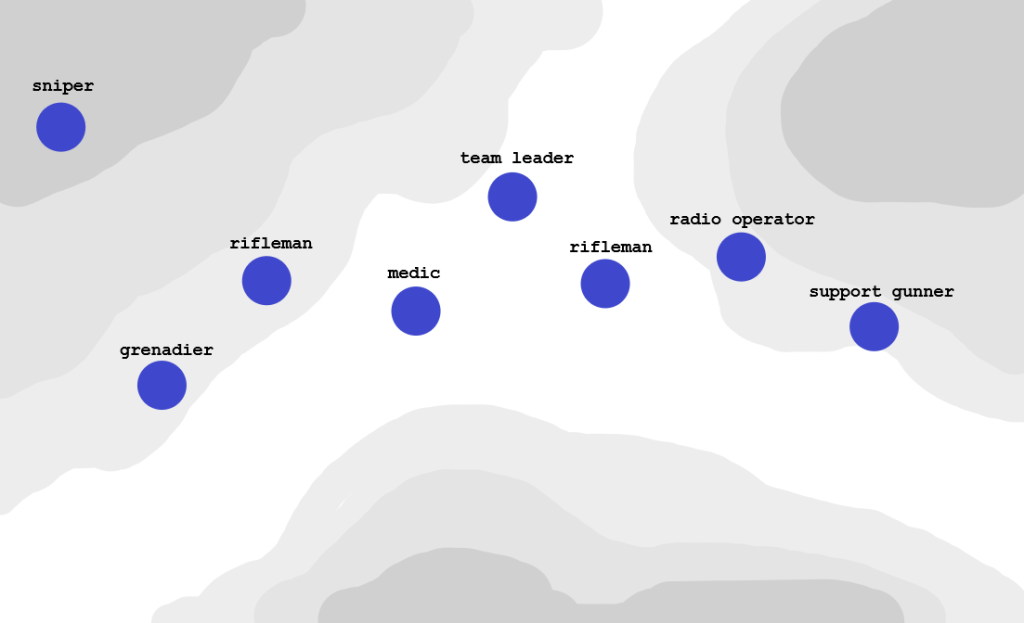
Here’s my imaginary airsoft team, we’ll call it C-4. I’ve filled it with a range of roles that you might expect from a team. And I’m going to talk about roles from a different angle. Now, if this is my team and we’ve been invited to a random event somewhere new, there’s going to be an element of surprise in terms of what we’re going up against and how we’re going to approach the game. Might not even know the rules or details in advance, depending on who is organising, but we’ll go anyway.
In airsoft, no plan survives the first contact. Looking at this team, if the leader gets hit in the first firefight, then we have nobody automatically taking control of the team. It’s a free for all of different ideas, and likely a debate over who steps up. This is why it’s important to have a 2IC, or second-in-command, announced in advance so that there’s no debate and the team continues to be led in the field.
The medic here may or may not be needed. Some events declare everyone as a medic, some run games with no medics (you just go back to respawn), so it’s rare to need a dedicated medic. In a firefight, that medic might not actually be near or nearest to the casualty. Having someone who is in the real world a trained first aider or doctor is always useful for any actual injuries, but that doesn’t necessarily mean they have to be thrust into a pretend medic role.
The radio operator is going to be the link between HQ and our squad. Someone who knows how to operate a radio, but this is airsoft so they’re not getting bogged down with extra antennae, Vietnam-era phones and a massive bulky backpack containing a vehicle sized radio setup. Programming radios is again an asset to the team off the field, but if our R/O is hit out then we’ve instantly lost all contact with HQ, and from previous experience that’s a huge problem. Additionally, the orders from HQ should be going to the team leader or whoever is in command, and via the R/O first means adding an extra layer to that communication so there might be an argument there for the leader to have direct contact with HQ. I’m not bothered about comms with other squads, because that’s kind of what HQ net is for. If there’s another squad who wants to work closely with ours, then we can all just jump on one channel at squad level.
Dual channel radios are excellent investments for this sort of reason – you can have several dual channel radios set up with one channel as squad, and the other a line to HQ so that other people can step in and take up the role if and when the R/O is gone. A dedicated radio person off the field though is a must to maintain and program your team comms, as much as a team tech is to keep the guns working.
Support gunners are able to put down a lot of fire, but some sites will prevent support weapons being used indoors so depending on the task, that means the squad is a man down while attacking a building for example. Loud, constant automatic fire from an LMG does give your position away, and they’re unfortunately not the most reliable of airsoft weapons so there are advantages and disadvantages. Suppression could be laid down by teams of riflemen, and from more directions if needed.
The grenadier is another specialist role that is needed in certain situations. Every player ideally could carry pyro for door breaches, because you can’t choose who is available or in a position to do the breach. If you look at grenadier as a mortar or underslung launcher for tag rounds or similar, it’s a weapon that is capable of big impact, but not often or regularly. I’d likely swap out that capability and have all the riflemen carrying individual grenades for flexibility. A grenade launcher is a useful extra weapon added to someone else, but I wouldn’t dedicate a special role to it.
The sniper is the last role, and a very useful recon element which can scout ahead and feed back intel on enemy positions so that the rest of the team are one step ahead and know what’s coming, and where from, which means the enemy lose the element of surprise. However, I’d equip that sniper with an assault rifle instead to allow them to rejoin the squad when needed for things like building assaults or defending a position (the AR is going to be capable of putting down a lot more fire than a bolt action), so they can be used in two roles. It would be useful to use someone who is used to playing as a sniper and they can certainly add extra camouflage, to help with the recon side without hindering their ability to operate as an extra rifleman when required.
So, how would I set a team up? Like this…
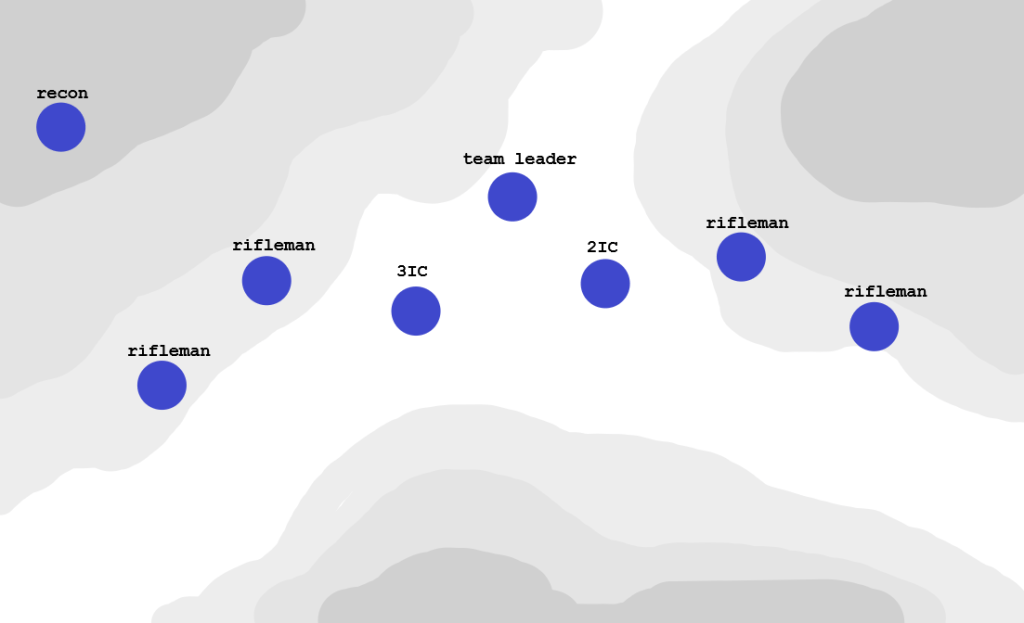
There are three leaders here, because I know what airsoft is like once everyone starts shooting. So there’s a backup to the backup, and they’re all equipped as riflemen. The recon role will be a rifleman skilled in stealth, preferably a sniper but equipped with an assault rifle. And, err…yeah just riflemen. Why?
Because that’s the most flexible role. I don’t know what the event holds, what capability the enemy has, so adaptability is key. If I knew the team would just be sat in a pillbox all day at every event we do, I’d switch it up to all support gunners. It might look really boring and basic but as with sniper/spotter combos, I’m a firm believer that every player should be fully capable and not rely on others because full squads don’t last long in airsoft. But the rifleman isn’t some random kid with a rental gun. It’s a skilled player. And we’re going to set them up with:
- An assault rifle. Ideal for attacking, defending, suppressing, entering buildings, and riding in vehicles if needed. It isn’t subject to MED or other limitations.
- Enough ammo for it so there’s no need to rely on ammo bearers or buddy mags.
- A radio, ideally dual channel, to communicate with all friendly elements.
- Grenades and pyro, for breaching.
- A small first aid kit, just in case.
- Torches, for fighting in dark places and to combat NVG’s.
That’s my theory on teams and team roles anyway, be interested as ever to hear comments below.
 Stipsniper.com
One thought on “Team Setup and Role Management”