Good gear makes a good player.
Good gear is not expensive gear.
Good gear is the right gear.
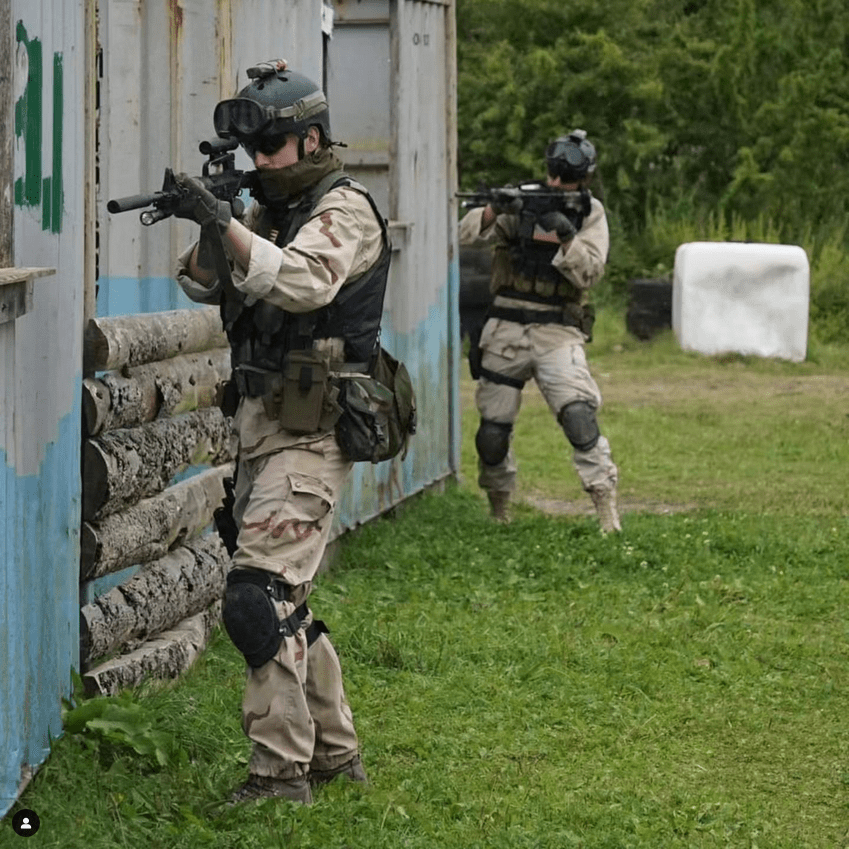
We are blessed in Airsoft to have vast amounts of kit available from nearly every military on the planet, plus a lot of Airsoft companies producing cheaper versions, plus their own designs, and you can even play in fancy dress. If Airsoft had a catalogue for all this gear, it would probably deforest a whole country. Every player has their own style, those in teams will perhaps have restrictions on what they can wear, so I’m not going to sit here and tell you what to buy. Your vibe is your vibe, and you do you.
But.
Think about what you’re buying first.
Genuinely, it’s the little details that make the biggest difference.
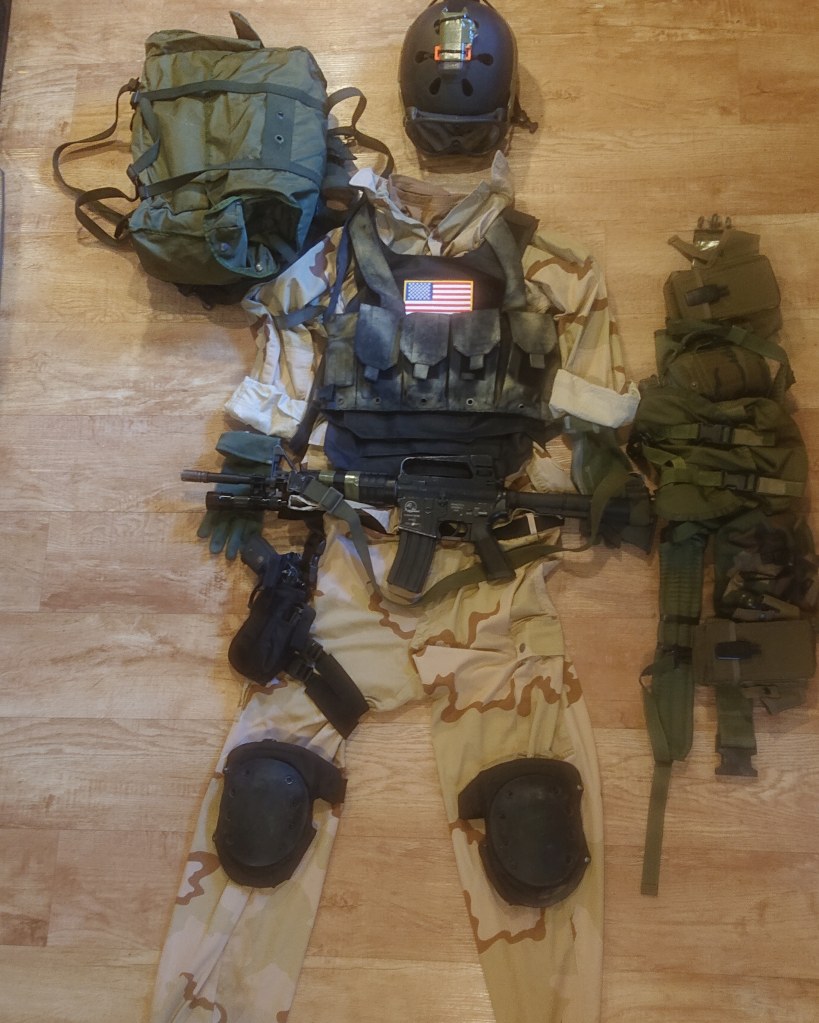
Airsoft is a very physical game, so what you wear needs to allow you to run around and move without being restricted – even if you’re a patient player like a sniper, there are still moments where you need to move somewhere quickly and efficiently. Anything you buy that looks cool but restricts you is a problem. Excess weight is also a problem. Some of the worst things I’ve added to loadouts are :
- Big heavy coats
- Wellies
- Helmets
- Plate Carriers
- External knee pads
- Shoulder bags
- Full face masks
- Belt orders
All common, all were cumbersome and added little functionality. Helmets are heavy and unnecessary (it doesn’t hurt that much), shoulder bags would fly around my body when moving, external knee pads eternally fall down and need constant adjustment. These are little details that became a major annoyance while playing. Similarly, what you do wear should have straps adjusted so that everything sits tightly on your body and doesn’t flap or bounce around – tactical belts that you wear through your trouser belt loops are great for a holster and maybe a couple of pistol mags, but don’t add too much weight to something that’s holding your trousers up otherwise they’ll come down. And I don’t care how much you paid for it or who wears it in the real world. Make sure that all pouches are closed so that you don’t have to keep checking for things falling out; today I’ve seen a player decked out in plate carrier/belt order with elastic mag pouches trip over while running and have primary weapon mags fall out of the open top “speed pouches” – you’ll need mags when the shooting starts so make sure they’re secured. Closed pouches are much more secure, but only if they’re closed. Eye protection, face protection and headwear needs to not restrict your vision or hearing. Tie your laces properly.
On the whole, less is more, especially if you’re just doing a single day skirmish. A lot of fun looking bits and pieces end up unused and just getting in the way. However, when you need to carry stuff you need enough capacity for your kit. I’ve always maintained that load bearing will make or break your day. I have more load bearing than guns. Hell, I’ve probably got more rigs and pouches than bb’s at the moment. And I would always choose actual carrying capacity over some high-speed, low-drag minimalist setup.
Your rig is there to ensure you have what you need, when you need it. For a typical skirmish game day, you’ll want :
- 4-6 mags for your primary weapon, whatever that is
- Pyro
- A radio – essential, more on that later
- A speedloader
- An empty pouch
That’s easy enough. The empty pouch by the way is to put empty mags in during a game if you’re struggling to get it back in the pouch it came out of, and after games is extremely useful for holding your gloves or other things you want to put down for a second. But, what if your site decides to do a longer game day? Or you want to travel to a site where the only break is for lunch? Then you’ll need extra :
- Water
- Food
- Bag of bb’s (never bottles, they rattle)
- Spare batteries (radio and gun)
Always look at the modularity of your load bearing. Think about future uses. What you don’t want, unless you collect like I do, is a new rig for each event. Molle systems are easy enough to slap extra pouches on, although sometimes its a case of attaching a pouch to a pouch because you have a plate carrier the size of an iPad for example.
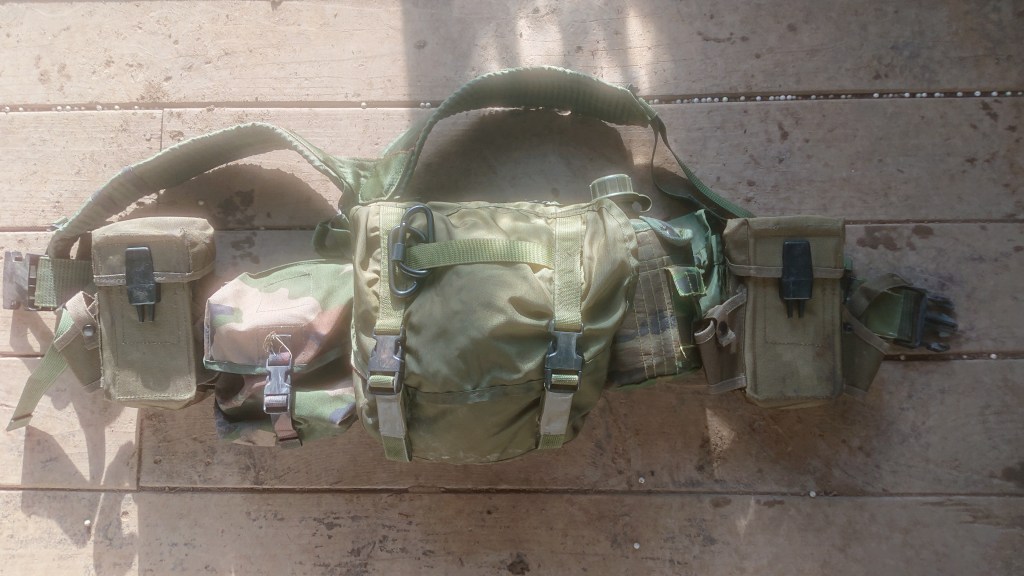
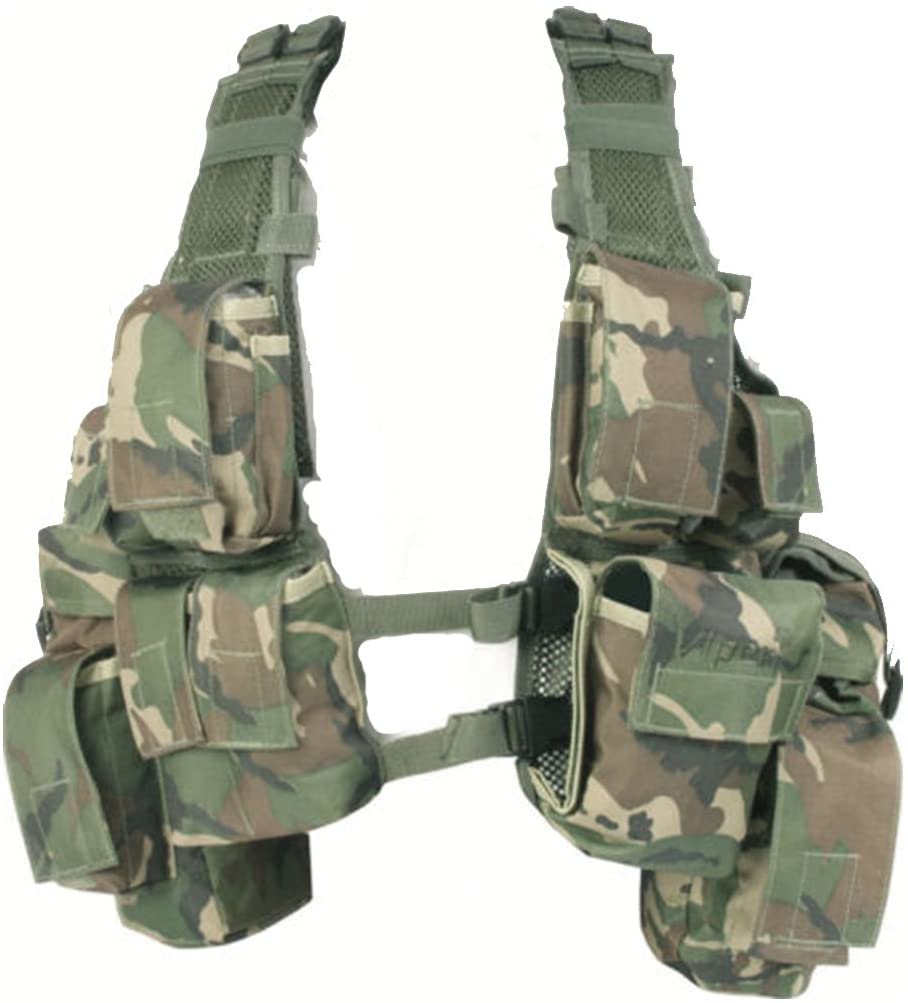
(Left) ALICE and PLCE belts and harnesses are cheap enough and give you a lot of scope for expansion, depending on your waist size. (Right) Or get something with enough capacity in the first place that you’ll never need to add anything to it. You don’t have to fill every pouch unless you need it, empty pouches don’t exactly weigh much, most of my rigs empty must weigh about half a can of beer, so once they’re on I’m not going to notice any difference. I know micro rigs are extremely popular at the moment but have never worked out why – they really don’t make you any faster; more often they slow you down when you need something but had to leave it in the car because your fanny pack couldn’t fit anything else in.
Do make sure you’ve adjusted your straps correctly and roll and tape any loose straps. Check everything is secure and tight to the body to reduce excess movement.
Radios
Get one. We used to use them a lot within teams, but radios are rare at most skirmish sites. Get a Baofeng UV5R – they’re cheap, decent enough for what we need, have plenty of antennae and expanded batteries available and they’re really easy to program (just type a channel number in and hold down the lock button). Radios allow you to pass info to teammates, receive info from teammates, find out what is happening and where, and give you the bigger picture of how the game is going. Think of Airsoft as a game of manouevres, with some shooting, and that radio is your guide to where to go. It’s essential.
Guns
Of course, you’ll need a gun. Which one? It’s up to you. Everyone is different. But don’t go loading it up with too many unnecessary accessories. Most of mine just use iron sights (blog here on my classic M727 build explains why). A couple have vertical grips which are great for keeping your arms tucked in. For darker sites I’ll add a torch. That’s it. Lasers just show the enemy where you are. Optics are rarely used even by those who have really good ones. And all the weird and wonderful grips…well, you could just hold under the barrel like a normal person, it’s not like we have to manage recoil.
The only other advice would be to not try and over-engineer the gun. The more you do, the more goes wrong, and every game day I sit and listen to “tech X fucked this up” or “tech Y needs this back to fix properly”. Even the experts make a mess trying to upgrade every single part in the gun. It’s expensive and to be blunt, the higher rates of fire just cause excessive reloads, and the extra range really isn’t as much as you think, and it doesn’t make you any more lethal. Keep things simple, functional and reliable. And then we don’t have expensive mistakes like guns coming back into safezone because the mosfet shit itself and the motor is on fire (you know who you are).
I don’t like delicate, pretty guns for the fact that at some point it’s going to get dragged down a hillside in the mud, or dropped from a window. All the mounts, scopes, cameras etc are weak points that break easily under pressure. I also rarely use slings (my classic one has an old school Vietnam issue sling on as part of a Gothic Serpent loadout), because moving through difficult terrain it’ll either catch on every piece of vegetation or I’ll need to detach myself from the gun to crawl into position. The only time I really see people using slings is when they’re just standing around staring into space, or complaining loudly to everyone that their LMG is too heavy.
Gadgets
Anything extra is either going to be a bonus, or a hindrance, once you have a gun and a radio. Yes, we can tool ourselves up with all sorts of weird and wonderful extras. A lot of kit serves as a mounting point for even more kit, that’s why we have molle and rails. Sometimes it’s like watching kids with Lego, just adding more and more shit purely because they can. But just because you can, doesn’t necessarily mean that you should. A few thoughts on some of the more common ones then…
- Torches – Yes, I take a torch sometimes for dark areas. However, if you do run one, mount it on the gun and not on your head. That means that you’re using your gun to look and investigate dark rooms, rather than turning your head and then having to bring the gun round to meet it. I know there are tactical videos that tell you your head moves fastest so it makes more sense being on there, but if you have to make a second movement with your gun anyway it just doesn’t make sense. Red filters will ensure you’re not illuminating yourself to much, and when it comes to buying a torch don’t be one of those people who looks for the brightest or highest lumens possible – it’s not a flex, you’re just going to let everyone know you’re there. Don’t forget polycarbonate lense protectors. Red Dot Engineering on Ebay are great for keeping your torches intact.
- Helmets – I’m including lids because they’re really not necessary yet are one of the key mounting points for extra crap. Big, cumbersome, head-movement-reducing lids look good, but that’s about it.
- NVG’s – Night vision is everywhere these days. Now, I’ve played without for decades but I know how to play in the dark (see blog “Fight the Night“). What I find odd, bar the amount of players posing with them on Instagram, is that most skirmishes take place during daytime hours on a Sunday and players still want to wear them. They’re affordable, but not essential. Again, bulky head restrictions.
- Novelty masks – Ooooh yeah, look at you, you’re so unique. But these skull/hockey/Predator/clown/cat masks etc are limiting your vision. Peripheral vision is lost to a wall of plastic and if it has mesh eyes, then it’s affecting the one direction you can see in. A lot of them don’t take BB hits very well either, so be especially careful if you’re not wearing eye pro underneath. Save it for Halloween.
- Lasers and tracers – Pretty coloured lights and effects are great for kids’ parties, but in a dark environment they’re going to give your enemies a nice easy line to follow to find you. Don’t make it easy for the opposing team.
- Multiple optics – Flip to side magnifiers, 45 degree mounted backup irons etc. Realistically, “zoom” on a gun isn’t needed when you can only hit 60 metres anyway. It’s just not far enough to say “yeah I have this 4x zoom for longer shots”. I can fart further than that. Watching people tilt their gun to 45 degrees to use their backup optic just tells me that the main optic isn’t right. Most of my guns now just have irons, it’s just a reference point really.
- Phones/flip down tablets – You know the sort, mounted on the chest in a flip down case. High velocity plastic balls and screens are not friends, and I know some people really struggle to put their phones down in case they miss an influencer post, but you don’t need your head down in a screen during a firefight. Having something valuable like that strapped to your target area also causes you to play a bit more carefully. If it’s a big game and you’re using something like Ares Alpa to track players, then you’ll need a device but keep it somewhere out of the way, like padded pouches or a backpack, until you need it.
- Drones – Skirmish? No. Big game? No. Noisy and fragile at the moment, although I imagine technology will soon fix that. Drones can be useful for observing the enemy if fitted with cameras, but you’d need to put your weapon down to fly it, and you’re probably going to want to bring it back which will give the enemy your location so make sure you’re in a safe space.
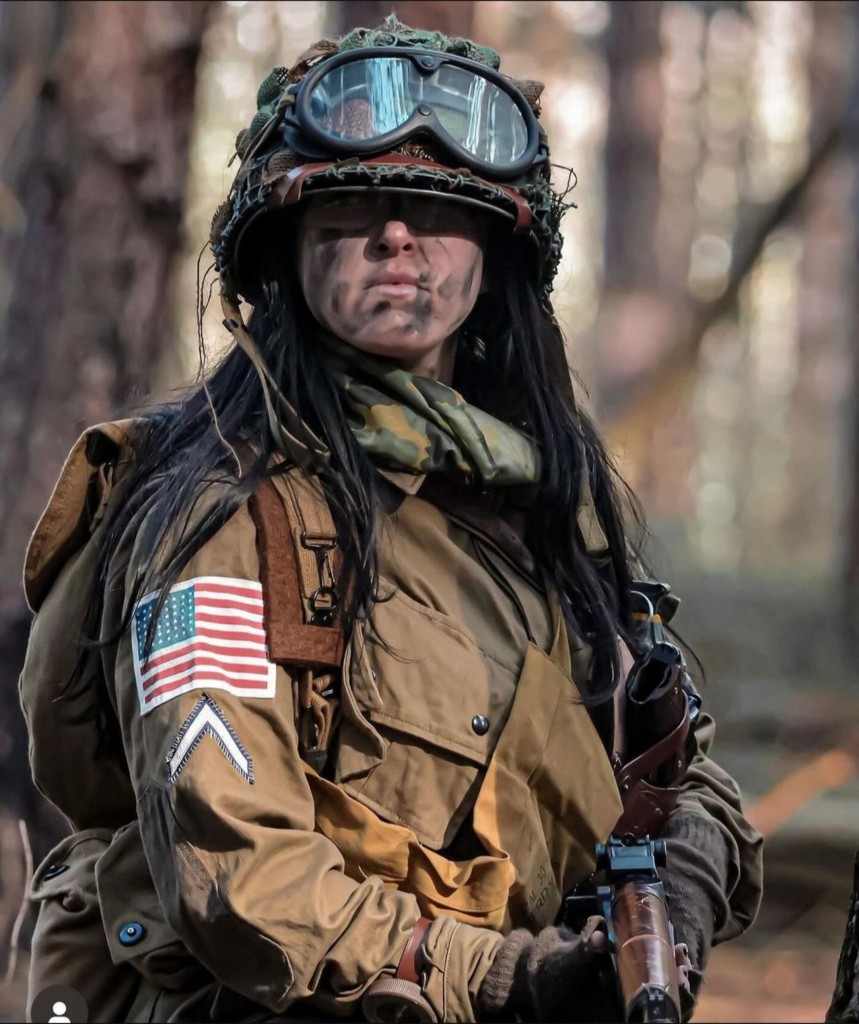
I’m not against Cosplay or reenactment, sometimes you might want or need the extra kit, but if you’re there just to play the game, light is right. It might be that a Milsim has specific kit demands that you can’t avoid,but if you have the choice then it’s definitely not a game where spending more guarantees you more success. In fact, it’s usually the opposite.
Camouflage
Does camouflage work in Airsoft? Of course it does. And it’s not just limited to snipers – if you can stay undetected or at least unnoticeable for just a few seconds it gives you the advantage and the opportunity to fire first. Do not underestimate the advantage of camouflage. If you’re into black, multicam black, urban camouflages, or playing in a tracksuit, you are going to be spotted first. What camouflage works best in your environment is a whole different topic and I might cover that one soon, but camouflage extends beyond the pattern on your clothing. Look at areas of skin that are on show, black guns (add some tape to break it up if you don’t want to paint it), shiny silver areas etc. You’re reading the world’s biggest sniper blog, there are loads of articles on camouflage here. But in addition, especially in CQB arenas, tighten up on your noise disciplines. Add tape to sling mounts, tie up and tape all your loose straps, make sure nothing rattles. Learn to stop talking all the way through the game. As above, you’re just trying to not give yourself away and even if it buys you a second or two, that’s your advantage over your opponent. Again, there might be team camo restrictions in play or other limitations on your clothing, like perhaps period gear, but that doesn’t mean you can’t do a little extra to boost what you have.



 Stipsniper.com
One thought on “Choosing Gear”