Airsoft, from the outside at least, is a game about shooting. There’s a lot more to it, but ultimately to gain most victories, you’re going to have to attack people. There are hundreds of videos online from real steel shooters, but in truth Airsoft is a vastly different proposition because of four main factors;
- There’s no recoil – so you don’t have to worry about shouldering the weapon or putting on that C-Clamp grip because Travis Haley does it. You can shoot from absolutely any position you like.
- The BB’s don’t follow a straight flight path – they’ll drift in a slight breeze, even a blade of grass will throw them off, and with bad ammo you’ll get fliers and loose groupings even at short range.
- Nobody dies – So nobody cares about getting hit. It only hurts a little bit. So it’s a lot more aggressive.
- We carry much more ammo – A typical skirmish player is likely to have 500 rounds in mags on them, and likely a bottle of 3,000 more handy. We can easily go nuts on the trigger.
As cool as those tactical shooting videos are, and I love Tu Lam, they’re not always that applicable to what we’re doing and there’s only so much that can be learned from them. In terms of the actual shooting of the gun, just make sure that if you’re using a scope that it’s zeroed in correctly and the hop is set for a straight flight path. Without recoil, there’s very little need for any technical shooting stances; it is largely point-and-shoot, especially at our short ranges.
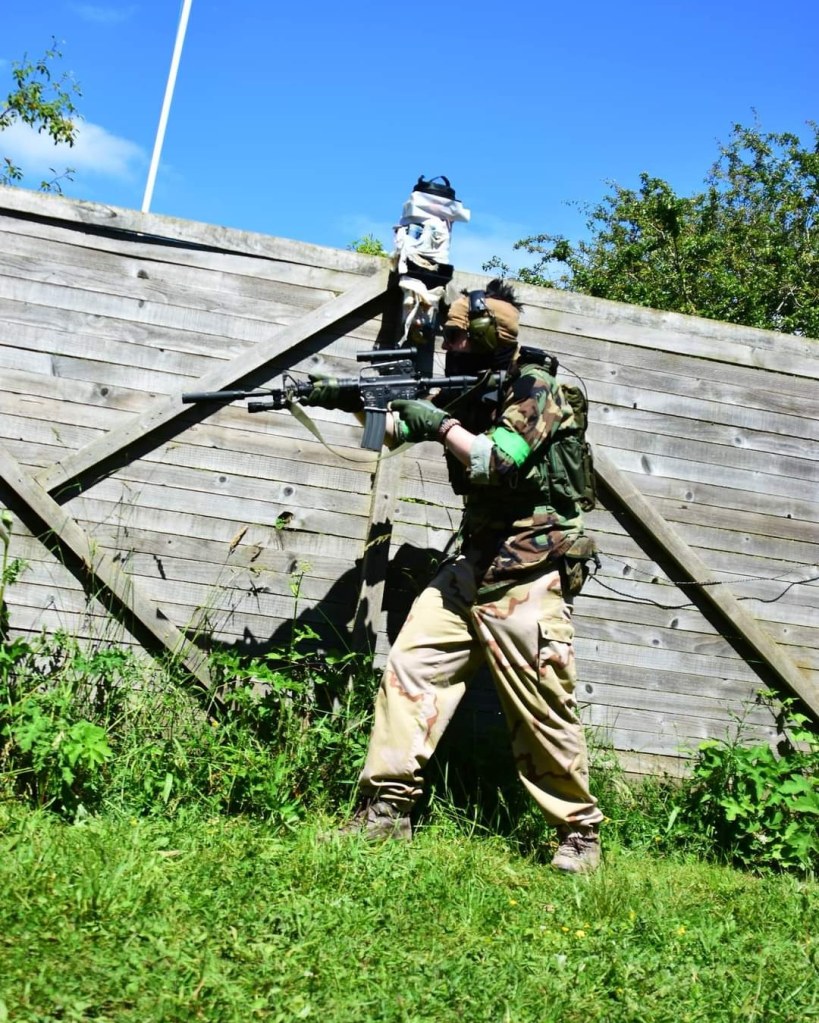
It is important to be ready though. If you’re on the attack, you’re expecting to pull the trigger, so make sure the weapon is up and you’re ready for the engagement. It’s often a case of fastest trigger wins, so if you’re not ready and your opponent is, you lose. In the picture above, on the other side of the wall are enemy players. Lots of them. And I’m the last man standing (bar the photographer). I know they’re going to come through a doorway at some point, so am I hell going to take my finger off the trigger or lower the weapon. Although defending in this scenario, if I was attacking I’d be doing exactly the same – weapon up and looking for work.

Another tip is that when you’re looking around, try and look with the weapon so that if you do spot anyone, they’re in your sights. Yes, I know Haley did a video saying that the head and eyes move much faster than a rifle to spot incoming threats and awareness is important, but once you spot somebody, you’re not going to shoot them with your eyeballs. You then have a second movement to bring the weapon onto the target.
In both of the pictures above, you might assume I’m a left handed shooter. I’m not, I’m right handed but one thing I learned early on was to be able to transition the weapon and (sort of) shoot left handed in situations where I don’t want to expose my body moving around a corner. Which brings us nicely to one of the fundamentals of CQB – not exposing yourself. And I don’t mean dropping your trousers to gain the element of surprise, although you would very much surprise your opponent. And the marshals. And probably the police…
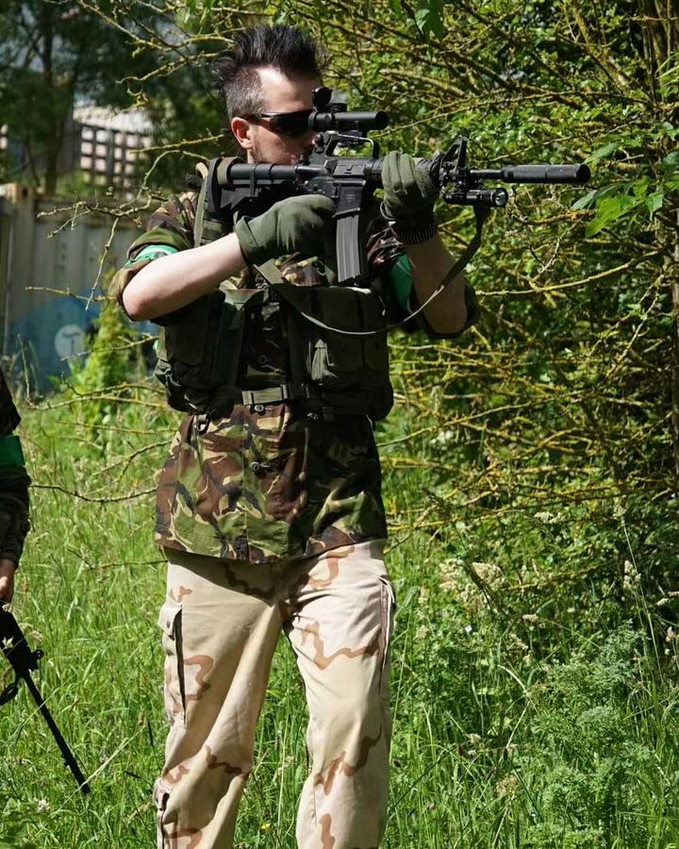
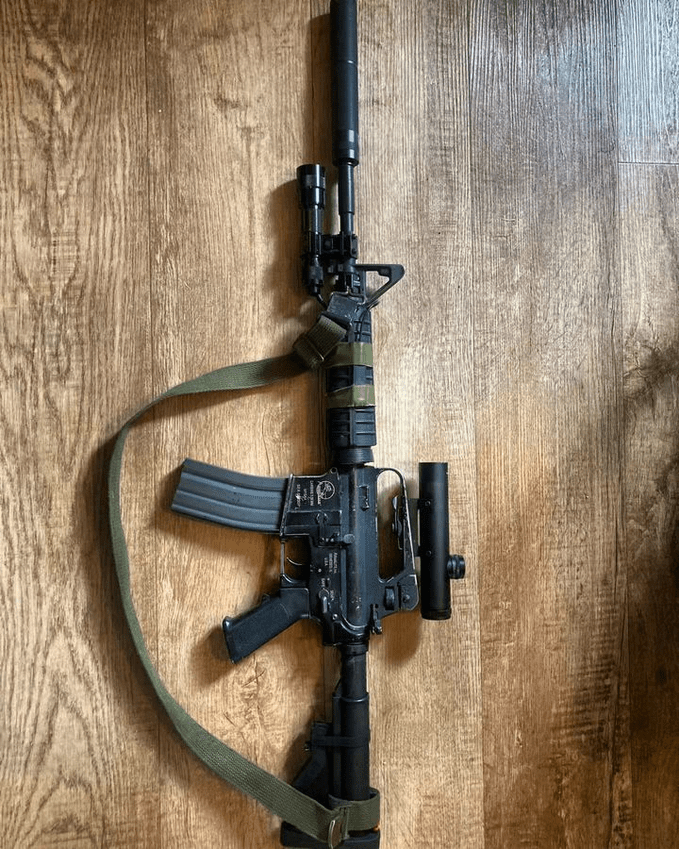
This is genuinely my CQB gun. It’s a bit different to those ARP9 or shorty Mk18 CQB builds. Because it’s a couple of inches longer than a full size M16. I don’t even switch to a pistol to enter a room, but that’s primarily because I don’t have one. Honestly, I don’t struggle at all moving in and out of buildings with it; it works much the same as shorter guns in terms of manoeuvrability. All I have to do regardless of the gun I’m using and the size of it, is make sure I’m not poking the gun through the doorway and letting people know there’s someone there. So I might stand a few inches further back – it’s ok because the range will cover it. It’d probably be different if I was trying to have a firefight with four other people in the back of a Ford Transit. I know that challenges the herd thinking when it comes to close quarters battle but that’s reality vs theory for you. It’s obviously shorter if I take the silencer off, but it annoys @Bubba being on because it’s not historically correct so it stays on. Additionally the extra length when I’m in woodland is a considerable advantage when using vegetation as cover because I can sit deeper into it and still have the unobstructed barrel sticking out the other side, but that’s a separate lesson.
What I find with players who run, for example, a pistol connected to a drum mag connected to an HPA bottle, is that they lead into rooms with their arm and shoulder because the gun is so short, rather than leading in with the barrel first. In the old days of Airsoft, it was common to run vertical foregrips on rifles which cause a player to tuck their arms into their bodies to reduce their profile, but that wisdom seems largely gone now in favour of c-clamping a long gun so that you present your hand and forearm to a hostile room first. It’s a bit like poking your head around a corner not knowing what’s on the other side – lead in with the gun, be ready and don’t give them much to shoot at. Expect every room to have someone inside with a gun trained on the doorway you’re coming through; I would if I was defending it. Watch your feet and legs too – they don’t want to go in first.
Building Entry
There might be times when you can “pie the corner”. I’m sure there are groups who run CQB training courses just to teach this and then feel like it’s high level course content. Pies are easy. Always think of pie when you approach a door. Or the fast food van.

Its a way of circling a doorway to check what’s inside. In the above example, you’re going to start at 1 and without exposing too much of yourself or your weapon, check as far into the room as possible through what is (at the start) a very narrow angle in the door which is good defensively. I was going to say slowly move, but in reality it doesn’t matter how slow or fast you do it. Next step is to circle the doorway (2) with the weapon ready and check the room out as it’s uncovered to you, finishing as far round as necessary (3) to clear the other corner. It’s like a room sweep with a bit of protection provided by the walls either side of the doorway. The idea is to check a room as much as possible before entering it, and this is where a lot of new players perhaps get it wrong and they’ll excitedly run into a building and then try and assess their situation once inside.
Assume in every building there’s a gun on the inside pointing at the doorway
Do not underestimate the advantage of dropping a grenade through a doorway to clear a room as either the enemy freezes and takes the hit, or retreats back into cover. Mass kill potential. But make sure you follow it up. Speed and aggression when taking a building works really well. Go loud, go fast. Shock and awe. Burst in before they have time to react; you’ll find 90% of players do actually freeze for a moment unless they’re expecting it.
OR,
Play it like a sniper. I have to put this in because it’s my preferred approach. Move quietly, step carefully avoiding scraping your kit against walls and other surfaces, and surprise your opponent who doesn’t expect you coming. Remember that in the chaos of most Airsoft games, if you hear footsteps coming down a corridor there’s no immediate way of knowing which team they’re on. If you’re breaching with a lot of noise and shooting your way through, it’s obvious that there’s a firefight coming and players will be ready for it. Learn to take people off guard. At a recent sniper training event, our guys were put through their paces taking buildings using pistols avoiding detection. Viable, but does leave you lacking firepower in terms of ammo capacity and fire rate. In this approach, you still need to be quick and decisive before they figure out which team you’re on. If you’re not sure what team they’re on, shoot anyway. Yeah controversial, but in this scenario you have two outcomes.
- They’re enemy. You pause to identify. They don’t. You die.
- They’re enemy. You don’t pause and open fire quickly before they’re ready. Room cleared. You live.
Sometimes this is the problem with being stealthy and I don’t support killing your friends but sniper is all about staying alive regardless and although the ideal situation is that they’re not friendly, sometimes you just have to stack the odds in your favour. I know I’ve written plenty of tactical blogs in the past about being a force multiplier and helping the team effort, but that’s out in the field with the rifle being in control of the situation and not turning a corner in a darkened building and having 0.01 secs to weigh up your options.
The problem is when you’re not doing either approach 100%. Throwing grenades in but not aggressively pushing a building, hesitating and giving your opponent time to recover. Or trying to sneak in but not having a weapon up because you’re busy chattering away to your teammate. If you’re going to attack, commit to whichever approach suits you best. And it’s not just limited to buildings. If you’re attacking positions in the woods, apply one of the two approaches but don’t stop halfway and think “shit, maybe I should have done the other thing”. It’s the pauses and hesitations in Airsoft where we make mistakes. The worst case is that you get hit and have to walk back to respawn, you learn from the experience or the mistake depending on how you view it, and you do it differently the next time.
Every time you get hit, accept it, shut your mouth and learn from it and you’ll develop as a player. Start kicking off and blaming everything and everyone else, and you won’t. Every mistake is your fault, and if your gun fucks up that’s your fault too. Own it.
 Stipsniper.com
One thought on “Shooting and Attacking”