As much as we’d like to believe some of the absolute “weapons” on social media that think they can win games on their own, Airsoft is a team game. It might be the classic two-team game or perhaps you’re fighting in lots of small teams of 4, but you have to work together to achieve objectives – you’re not going to beat a whole team no matter how sponsored you are.
For ease, there are two uses of “team” in Airsoft and to make this article easier to understand, I’ll separate them. I’m part of a team with my mates, we might have 5-10 of us at a game day and that’s “my team“.

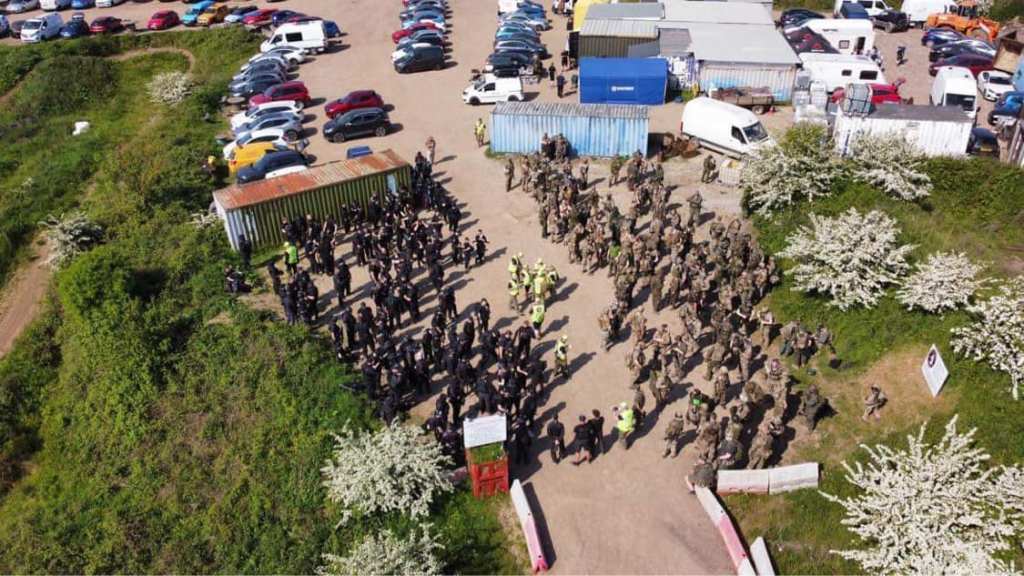
It’s probably more correct to call this a squad. Yes, it’s my Airsoft team in terms of media channels etc, as in a sports team, but if I go to a game day at a site, it’s a squad within the larger team. I’ll use last year’s Op Irene as the example here – we’re playing Black Hawk Down. Our squad is part of the US Forces team that will face off against the Somali militia team.

I don’t know why we don’t use different terms across the board but hopefully that makes sense. For argument’s sake, let’s assume my squad of 10 are part of a team of 100 at a big game day. My squad, in theory, should be a fairly organised unit and we play well together because we know each other, everything is nice and friendly, and we should all be on comms together. But a squad alone isn’t necessarily going to win games; we need to help and receive help from the other 90 players on the team. I know these guys are capable of taking on objective in a big game, but on the whole we need to be able to work as part of the team. That will include people we don’t know, and won’t communicate with as fully, or might not even like but that’s tough; we just have to get on with the job.
Assuming everyone listened during the game briefing, the team will have an objective so we know what we have to do. It might be to capture a flag or whatever. Now, that time when you leave the safezone to go and set up in your team’s starting area is important not to “test” your guns by shooting puddles or trying to shoot your mates in the back, but to start talking to people outside your squad. What are they considering as a plan? What is their squad looking to do? At some point ideally, you’ll get a loud character on the team who will step up to play team leader – if nobody does, don’t be afraid to get your opinion out there and stand up in front of people or get your squad leader to do it if they’re vocal. It’d be ideal at this point to get everyone on the same radio frequency but I think there’s more chance of Novritsch becoming US President. At least have comms set up and ready with your squad if nothing else.
It’s important to listen to other people’s opinions and not to expect everyone to suddenly shout “SIR YES SIR” at your requests. However, by the time the marshal shouts “GAME ON”, you do need the framework of a basic strategy in place. It doesn’t really matter what that strategy is, as long as the whole team is behind it. Often games are lost when the team becomes very fragmented, is pulling in lots of separate directions and the lack of a coordinated effort leaves weak defensive lines and scattered attacks. So if our strategy is to attack from two sides, as long as the whole team is doing exactly that then you’ve got a good chance. What your squad is then going to do is put the tactics in place to enact that strategy.
- STRATEGY – The overall team plan (Team Level)
- TACTIC – The actions you’re going to take to achieve that strategy (Squad Level)
It’s important not to be a dick, and not to get upset if nobody wants to listen to your strategy. You’re still going to get some action and ultimately it doesn’t matter who wins or loses. The challenge to you as a player is how you set about the task you’ve been given, much like in the real world. If your squad is part of a suicide run through some heavily defended path to the main enemy base, then your job, with your squad, is to try and make that as successful as you can whether you agree with it or not. Minimise casualties, maximise the problems you’re causing the enemy. Be as difficult an opponent as you can be. And work together. Don’t be that wet wipe that walks off in a little huff because you didn’t get your own way or you didn’t succeed in what you were doing. Nobody likes a quitter.
A good plan that nobody listens to and has no coordination between squads will always lose to a bad plan that works because everyone is pulling together.
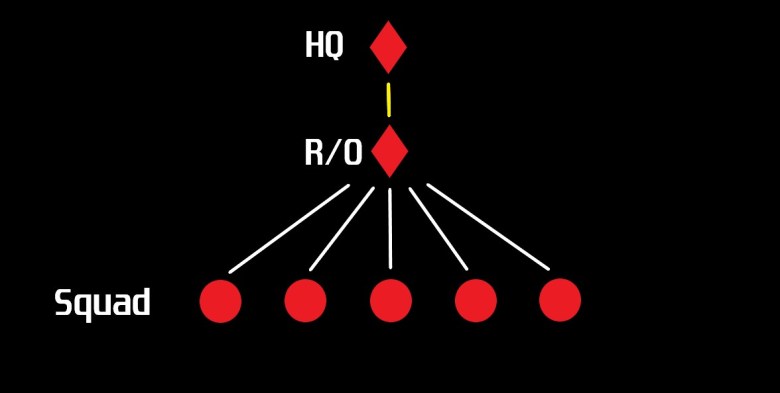
If you know what the overall strategy is then hopefully the team sticks with the plan and all you have to do is worry about what your squad is doing as part of that. It would be better if you had some sort of command net which put you in contact with other squads within your team, so you could coordinate with them, but very few teams carry a second radio for that purpose or a radio with dual channels. The easiest solution is to get a cheap Baofeng like this UV5-R and get your R/O to carry two, programmed separately. The UV5-R is dead easy to program so you can adjust it to whatever event you’re doing and it’ll always work. Assign a Radio Operator (R/O) to handle the traffic with HQ. Not the squad leader, they should be busy looking after the squad and be awake to the action around them. The R/O can listen to instructions, pass them on to the squad leader if it’s relevant (remember HQ can be passing info to 10+ squads so not all of it needs passed on) and then communicate any info back up the chain if it’s important. HQ don’t need to know if you’ve shot someone or seen someone nearby because your squad should be automatically dealing with that. They might want to know intel on objectives, whether you’ve lost your position, or any large enemy movements to help give them an idea of the whole battlefield. They don’t need to know that Steve has run out of biscuits and has gone back to his car or that you forgot to charge your batteries last night.
Identifying where targets are has always been a problem, the shouts of “he’s behind the tree” offers very little information to your teammates who are trying to locate the enemy. Knowing which way is north helps alleviate a lot of that, especially given that not everyone is facing the same way to use a clock face. If you can learn some basic hand signals, that’s a big help in quietly identifying threats and problems, rather than shouting. Making noise in the woods is an absolute killer. One of the easiest directional identifiers is simply to point your hand in the right direction, but only if your teammates are behind you. If they’re in between you and the target, you’re asking them to turn around and look at you instead of facing the threat. As a tip, if you’re a right handed shooter ALWAYS point with your left and NEVER take that finger off the trigger. Keep your weapon as ready as possible. If it’s heavy, try and rest it on something at least facing the right way and be ready to pull the trigger if needed.
On the noise front, there’s absolutely nothing worse than the idiot that yells during game “COME ON GUYS, LETS PUSH UP!”
Congratulations dickhead. You just let everyone in the area know we’re here and we’re pushing up. Honestly, I don’t like players who sit there and don’t push objectives but even worse are the guys that absolutely blow your cover, drop your whole section in the shit and then think they did a good thing by trying to lead the team forward.
Push up. We know push up. Everyone knows push up. We also know shut the fuck up.
The amount of times I’ve seen these “expert” players get up and start yelling and I’ve just wanted to empty a mag into them to take them out of the situation and let us get on without being lit up – and that’s being polite. As a sniper, I know the importance of stealth and not giving the enemy clues as to where you are, what direction you’re coming from and how many of you are there. For me, once it’s game on I’d rather everyone played in silence than started running around shouting at the top of their voice. Be a good teammate, don’t highlight others. Remember that what’s going on in your head isn’t what’s going on in their head. You might have someone laid up with a perfect line of sight covering a path to your position – what the hell makes you think it’s a good idea they get up out of cover and run with you into a hail of fire?
Within the Squad
A few notes on team building for your squad
- Get on comms – I’ll keep pushing this. And test before a game, not during. They’re really not that complicated.
- Balance your weapons out – A team of 10 with 9 snipers is going to do jack shit in terms of taking and holding objectives. And that’s coming from a sniper. But it also applies to other platforms. Infantry is the jack-of-all-trades building block of any squad. You won’t succeed if everyone is running a “special” weapon.
- Assign a team leader – ideally the most suited to the job, not the guy who created the time. I do admin no bother but I know in the field I’m not always the best choice for squad leader unless I’m the only one left.
- Assign a 2IC – A backup leader for when the first gets shot.
- Do make an effort to wear the same camo or similar loadouts – honestly, it makes all the difference when you can identify your squad members at a distance and know who is where. There are enough combinations and options out there to do it.
- Nobody wants your patches or merch outside your squad.
- Learn the basics. See Read more books! or Team Setup and Role Management
- Don’t have spare ammo on your back for your teammates to get to. We all know our guns are picky with different mag brands, we need those mags back, and mags on your back aren’t accessible by you when you need more.
- Don’t go bigging yourselves up all over Instagram when you’re a disaster in game. Quietly and humbly go about learning and improving your skills and show us how you get on. If you’re blabbing about being some implement of mass destruction, expect to become a bigger target in game for being cocky. There’s always someone who will happily slap you into next week. Stay humble.
- You don’t all need identical load bearing, just make sure that you know what goes where in your own rig and it’ll be fine. If you’re having to share mags, then there’s something seriously wrong with your own loadout that you’re not able to sustain and manage yourself properly.
- Be wary of having too many specialised roles – every player should be able to function if they get separated and that happens often. We can’t always guarantee that the sniper will always be protected by their spotter for example. Self-sufficiency is still important in a team.
 Stipsniper.com
One thought on “Working as a Team”