Ghillie Q+A, don’t worry this isn’t an erotic story…
But it is Valentine’s Day and today I got a lovely letter from Mike in the Czech Republic with some very good questions about making a ghillie, pattern control and adding 3D. So good in fact, that with his permission I’ve decided to answer them publicly because it’ll probably help a few other people out too who are going down the (infinitely better) route of making camouflage rather than buying a bag of shit off Amazon or some YouTube storefront.
Good day, Stip, I’m Mike from the Czech Republic. I have recently gotten into camouflage (I am playing with a DMR) since I started attending private weekend milsims with NVG and thermals included.
And since I want to build rather than buy, I would love to ask you for an advice.
A good start. Your private milsim weekends sound good already, and wanting to build rather than buy will give you a much better result in the long term and one that is suited better to your playing environment.
I have read your blog and tried to extract as much info from Le Covert’s posts as possible, but there is a concept I dont understand well (now I get it will require years of studying and testing on my part, but was hoping you’d share some knowledge to point me in the right direction  ):
):
Actually I don’t think camouflage requires years of study, which is the good news, although those who do study will get more out of it than those who think they can just buy a leaf suit and be done with it. I do think it would take years to sift through all the bad advice and store-bought solutions on the Internet though so I’m happy to help. You’re following the right people though and hopefully finding all the right information. Le Covert is a great teacher and if you’re reading up on stipsniper.com, you can’t go wrong…
THE ISSUE:
When building 3d patterns on 2d base, should I build the 3d elements on the underlying similar colour of the base layer? Or how do I choose the 3D macro patterns?
1) Say I’m building a BDU “ghillie” top for late winter (end of Feb and March, when its still muddy and dark, with little green in Czechia).
2) I only have vz95 (Czech camo) at home, but plan to order Woodland, Marpat, DPM and MTP to see what would fit the best with some adjustments (are Krylon spray paints okay for this?).
3) I would choose a base that fits the dominant colours (brown and grey in this time), and have it’s dominant colour be the visible 2D base, while enhancing the secondary (minor) 2d colours (less present browns, perhaps some green) with similar shade 3d elements?
To start at the start, the vz95 is an excellent camouflage for very green-dominant areas and summer woods but obviously less effective in the winter, much the same as where I am in the UK. However, if you have photos of the winter woodlands to study then there is still quite a surprising amount of green that survives even in colder conditions. It’s a good idea to have a balanced colour palette of green/brown/tan/black so that the suit overall doesn’t favour one particular colour especially if you’re having to move into different areas. MARPAT is becoming a hot favourite in most conditions but personally I find there isn’t enough contrast between the green and the tan colours. Tan is important especially in winter woods with lots of dead leaves and I’d prefer a lighter tan colour on the base.


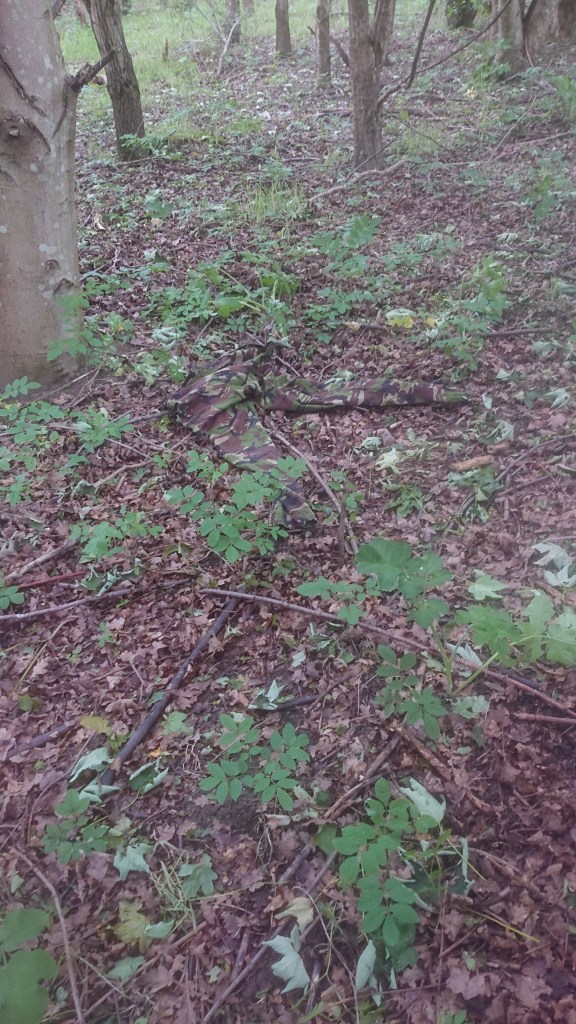

I covered DPM in some detail recently (article here) and despite being a very old pattern, the high contrast works really well to break up the outline and this is why I like to have that mix of dark/light in any pattern. These DPM trousers have not been colour corrected or modified in any way, and if it wasn’t for the fact they were laid flat and casting a sharp shadow on the edges they’d be very difficult to see even at this short range. The tan colour works well to match the dead leaves on the floor as well.
I do like US Woodland as well, but for where I play the green colour doesn’t match up to anything that grows here. Dark green, as Le Covert once said, is a very versatile colour and you could layer it with different green Haloscreen colours to suit the vegetation, but the layer underneath will still show. DPM has a very nice vibrant green which works with a lot of the new spring growth and weeds that grow all year round, so it wins. None of the above pictures have any filters applied or any colour correction. However, that’s my environment not yours, so if there are more dark greens and Pine tree type colours then the US Woodland may work better.
In terms of colour correction on the suit, I know many people will spray over the black because “it doesn’t exist in nature”, Le Covert included, but it kind of does – it’s just an absence of light or a shadow. Krylon is great but on a good pattern it shouldn’t need too much. If you’re using something like Multicam and need to adjust it to your environment then sure, add whatever colours you need to but the more you’re having to add the worse the base choice was to begin with. This is why testing is so important and why 90% of Airsoft ghillies sadly don’t work. You have to get it out in the environment before you add anything, then keep taking it out as you do. Take photos to refer back to as you do the work in your house.
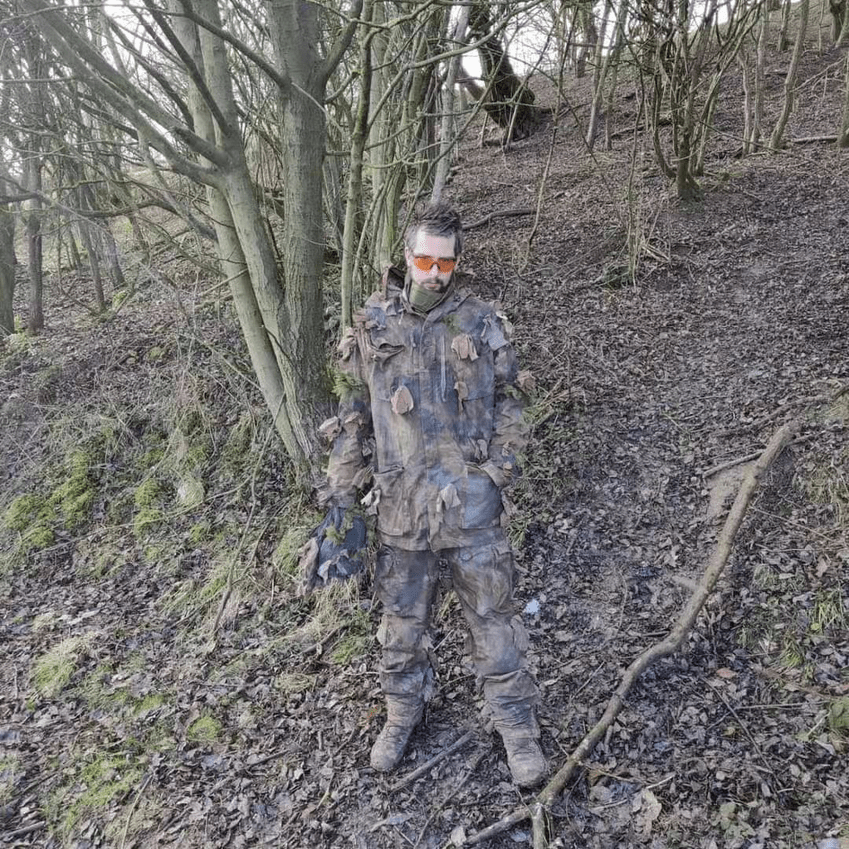
This was a few years ago, an attempt to create a colour-matched pattern using a desert DPM base. A mix of grey and brown spray paints helped create a very miserable looking “dead suit” which works well in extremely brown winter environments and mud but struggles in spring and autumn to break up the shape. The left arm here blends well with very little 3D but note how much green still exists in the background.
To answer your main question, once we’ve careful selected a base suit that works without any 3D elements, then yes we want to match the 3D elements to the base pattern to preserve and enhance it. The purpose of the 3D isn’t to cover everything up, it’s to eliminate the flat surface of the fabric rather than to hide the camouflage pattern. However, do use a few different shades on each area. For example, if you’re covering a tan area on the base, use a mix of largely tan but also a couple of other shades of brown just to break it up that little bit more. The macro pattern will still be there, but at closer ranges, we’re then breaking it up to stop it being too flat and uniform. You don’t need to cover all of the base pattern or colours with your 3D materials because as we’ve seen with the DPM photos, the base camouflage is already doing a good job and doesn’t need totally covered.
I’ve seen a newly released leaf suit where the leaves are a brown pattern but the base is green, and this is then killing any pattern to the camouflage and making it look like a mismatched mess – why have a base pattern if you’re going to cover it with something completely different?. Pattern control is important but as I look at it, it doesn’t mean just spraying the pattern to match the environment, it’s about having that pattern to begin with and using it. Go back up to the DPM picture and look again at how the pattern is working with, rather than against, the environment. New camouflage pattern designers may hate me for saying it, but I don’t think many have actually created anything better than DPM or US Woodland, although Pencott, Concamo, Phantomleaf and Kryptek aren’t far off. It’s kind of disappointing that in 80 years we’ve still not beaten the old gen stuff. Maybe we overthink and overcomplicate things.
My teammates have gen1/2 ghillies but that simply feels like an overkill when it comes to weight and are often not as effective. I had bought my Cobra hood from https://www.facebook.com/SniperGhillieSystems but that is for late summer and it feels cumbersome, although have never had any problems utilising it well in combat. But I was hoping – reading yours and Le Covert’s content – that I could do even better with less material, if only I chose a proper base and learned the pattern control.
Camouflage is important but even more important is your ability to move. For example, if you’re going to play a game of Airsoft, you’ll be putting a shirt and trousers on anyway because nakedness is a bad idea. If you go and buy a cobra hood or a leaf suit, this is just an extra layer you’re having to put on over the top of the kit you’re already wearing, so it makes much more sense to build directly onto the clothes you’re wearing instead. Old army shirts and trousers are far more resiliant, protect you better than mesh and don’t catch and drag on everything because they’re full of little holes. Even the thin mesh suits are an extra layer you don’t need – and before any fanboys jump on and tell me that “yeah but the new mesh only suit is fucking wafer thin and made from airsoft grade titanium weave and you won’t know you’re wearing it”, I don’t care, it’s still another heat trapping layer and the loose fitting is more a hindrance than a help unless you’re standing in the open doing nothing. Which, from recent game days, I can say that a lot of wannabe snipers are.
Sometimes I look at these mesh capes and wonder if they’re more for static display and photos rather than actual use. As snipers we have to crawl, run, leap over walls, pull ourselves through bushes and wade through rivers. Not sit on a pile of leaves while we wait for our photographers to get a few angles in. So we need kit that camouflages us but also allows us to play, and the big bulky gen 1 and gen 2 ghillies, as well as 90% of the gen 3, aren’t helpful because they’re hot, heavy and will affect our ability to move stealthily. A good sniper ideally needs to be fitter and faster than the CQB guys because we have more terrain to cover to get into our positions without being seen, so light is definitely right.
If I’m playing against a sniper and see them move, or hear them, then it doesn’t matter how good the camouflage is because I’ve detected them by movement or sound. Staying hidden isn’t 100% a result of the camouflage you’re wearing, it’s probably about 40% camo and 60% stealth behaviours (using cover, staying still, being quite) and a comfortable ghillie will help more with that stealth behaviour. I did an article on it that a lot of people didn’t read back in 2023 but actually explains it in a bit more depth. If I was to put together ten articles that I thought were the most important, it would make the list.

This diagram was the key point of the article – you can’t just buy a ready made suit and suddenly think “I have the power of invisibility” now. Less material is often better too; it doesn’t take as much as you think to break up those flat surfaces and if the pattern is doing its job and you’ve read and understood this diagram and associated article, you’ll be undetectable anyway.
One way or another, thank you for your content, you’re a great inspiration!
You’re very welcome. And one way or another, I’ll always take time to answer questions in the best detail I can and thank you for allowing this to be put together as a blog to help others. Content will always continue and I hope I can continue to inspire conversations around sniping, good or bad.
Kind regards
Mike
 Stipsniper.com