A common question in the prepping community, and one that forms the basis for your kit and kit preparation. Do you pack a bag and head out into the great unknown, or do you turn your house into a self sustaining fortress?
If you’ve read the first article in the “Survivalist” section, I’m not looking at doing any major work to my house. The focus here is definitely bugging out, because I want to look at it not only as a SHTF kit, but one for Milsim and wild camping as well. And a pantry extension with 6 months of tinned food just isn’t something you’re going to take to a weekend Airsoft event. This is my case for out rather than in. So, grab a bag and a beer…
Bugging in seems to be the default advice across most prepper groups because it’s easy and comfortable. In your own home, you have all your food and clothes handy (certainly more than you could carry), there’s shelter and a degree of warmth depending on the circumstances, and you can stay with all your valued possessions. You can make a stand in your kitchen with all those weapons you’ve been accumulating. The house is brimming with resources, tools and materials for you to use if you need to. It’s the “nice” option.
If you’re in a situation where you’re bugging in, it might be something as simple as a power cut, in which case you’re just living in your house as normal but improvising to cover the lack of electricity. Candles, hand crank generators, eating cold food for a short period of time until the power is restored. In situations like this, help is on the way and you’ll be returned to normal shortly. The area you’re in is safe, there’s just something missing that is proving an inconvenience to your normal daily routine.
The option they don’t like is bugging out. It might be that deep down, preppers don’t want everyone fleeing to the hills because the hills become crowded and competition increases.
Bugging out is uncomfortable. It’s human survival in its most basic form. Very little kit, no home comforts, only the food and water that you can carry. It’ll be as pleasant as the weather outside is. You’ll have to leave home. But, sometimes you might just have to, perhaps due to floods or wildfires. There might be unrest or riots, there might be war, there might even be some Google terminators that AI created who are hunting down anyone who doesn’t use Chrome as their default browser. We don’t know that at the time we’re building our bug out kit. But regardless of what happens, it’s the same solution.

There is something in your area that is a threat, and you need to get away from it. It doesn’t care if you spent £20,000 on an underground bunker in your garden, or EMP-proofed your shed. You need to get out of there and away from the danger, and you can’t lug those 500 litre water tanks with you.
What you do need is to take care of the basics until you can get to safety.
- Food
- Water
- Shelter
- Admin
I know admin isn’t exactly a basic human need, unless you work in an office, but you do need a means of assessing what’s going on around you, as well as navigation to help get you to safety. So we’ll lump all that together. Comms might be included as well if you have someone to communicate with. But we don’t want to be weighed down with too much gear – if you have to move, it could take several days and that’s not easy with a heavy pack. So when it comes to selecting kit, always look to cut back where possible and save a few grams here and there. We also want the most bang for buck as well. Tools that serve multiple purposes, are maintainable and repairable, as opposed to complex items that add functionality but at the cost of excess weight and less ability to escape.
Equipment choice is vital, because you want as little as possible but still enough to have what you need for most situations (you can’t plan for everything). I did an event many years ago carrying a 30kg, 120 litre deployment bag, and given that most of my combat kit was in separate gun bags, it was a lot. The following weekend I helped my two kids pack for an Army Cadet fieldcraft course, using only a 50 litre pack and I was stunned at how lightweight it was. I’d packed for a weekend, they’d packed for a weekend but the kit choices made an enormous difference. OK, they hadn’t packed as much combat gear (although still had rigs to carry navigation and cooking kit), but they got through everything just fine.
In the next few articles I’ll go over different bits of kit, but here’s a quick example.
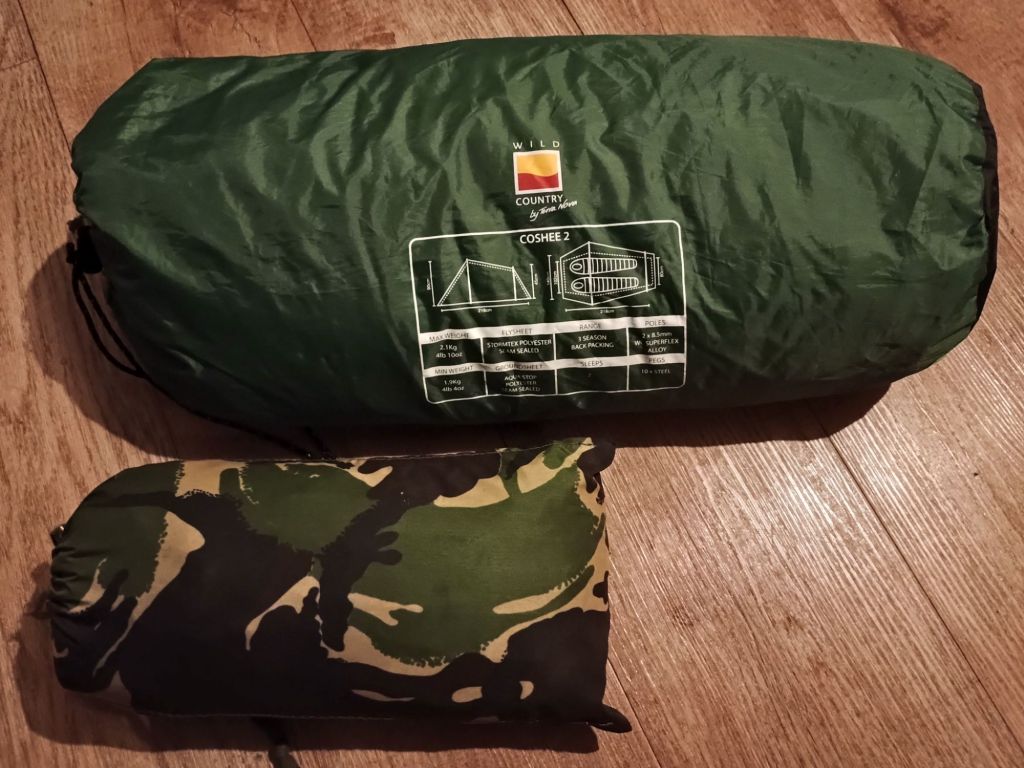
Shelter. A simple DPM basha (tarp) vs a small 2-man backpacking tent (Wild Country Coshee 2) which has been very good for me and I’ve had it on wild camps up mountains as well as Airsoft weekenders. Look at the size difference though. These are both doing exactly the same job; giving you some shelter from the elements but in two very different sized packages. Sure, the tent is nicer and more comfortable but in terms of pure function it’s still just a waterproof sheet over your head. The basha saves a lot of valuable space in the pack for other items. Although the diameter of the pack isn’t easily visible there, I could have four bashas, possible five, for the space of one tent.
All the bug out bag is going to do is take care of those 4 needs, and nothing more. It’s not a warfighting kit, it’s not going to have weapons because if we’re escaping from trouble, we don’t want to then go looking for more trouble and putting ourselves at risk because we really want to test that crossbow out against someone who may or may not be armed. Stealth and discretion keep you alive.
And staying alive, whether things hit fans or you’re out hiking for a few days, is vital.
 Stipsniper.com