Now the first thing I grab any time I’m heading outdoors, the A192 is an exceptionally good piece of kit. I’ll do a quick look at the product first, and then explain where it fits into my kit and why.
For a few years now, I’ve had one of these at the top of my wishlist, but as it dawned on me that the wife wasn’t actually going to get me one, I went and bought it for myself in spring 2025. The Stowaway Shirt was something I wanted for a specific purpose, which I’ll cover afterwards. If you spend any amount of time in the outdoors, weather is a problem. Be it wind, rain, snow, or if you live in Scotland probably all three for most of the year. You need ways to deal with the weather.
I picked up a plain OD shirt in XL off their website and the first thought when I opened the box was that it was quite a large fit. It’s designed to go over other layers but I didn’t want to gamble on going small (I’m normally an XL guy) just in case I couldn’t layer up underneath. But a bit of extra material isn’t a problem. It comes in 18 different colours and patterns at time of writing, from OD to snow camo, DPM to Pencott, which is really useful if you need it to match a particular camo.

So here it is. A super thin, super lightweight windproof layer with a hood. It has a DWR treatment on it, so it is showerproof but doesn’t have any taped seams for heavier rain. The hood is elasticated and has a quarter zip fastening, the sleeve cuffs are also elasticated to keep the heat in better, and the waist has an elasticated toggle so you can tighten it up. There are no pockets on it at all and that’s pretty much it. Just a well-made, simple layer. Oh, and it’s packable. Really packable…

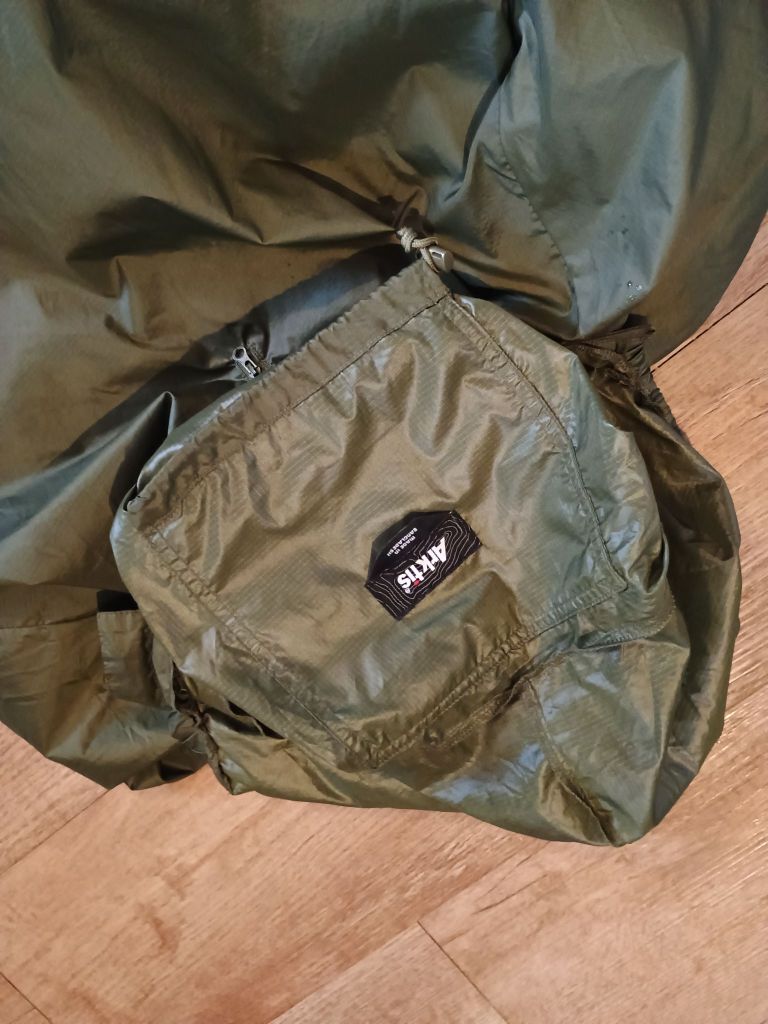
It could probably compress into half that space again if I needed it to, but that’s a very portable emergency layer which will fit easily into a pocket or pouch anywhere you need it to. It folds up into its own pocket on the back of the neck, so you won’t lose the bag it comes in. Originally, I’d looked at the TRC Outdoors “Cierzo” shirt, based on an original design in WW2 – SAS soldiers would cut up silk parachutes to make this extra layer, which is quite cool. But it featured an open neck, and I was wary about water getting in. The TRC Cierzo weighs around 170g, the A192 200g, but I’d rather the extra weight for a closed neck. I’ve been up mountains in thunderstorms (stupid, but exciting) with highly waterproof and Goretex layers on and still been soaked through because water has run through the face and neck area and soaked me anyway.

I’ve picked this up to use to keep me dry instead of a Goretex jacket, which might seem odd with it only being showerproof, but it’s as part of a system. It’s obviously much smaller and lighter than a jacket – my French Army issue Goretex wouldn’t pack even a single sleeve this small. And it’s quieter, bearing in mind that I want this mainly for Milsim use. But the keeping dry bit is where layering comes in.
Waterproof ratings on fabrics are measured in Hydrostatic Head (HH) which is measured in millimetres. A basic, high street waterproof jacket will likely be 3000 or 5000mm rated. Basically, this is the amount of water pressure it will take (literally a long plastic tube placed on the fabric and water added until the fabric lets water in, which is why it’s measured in mm). 20,000mm is considered totally waterproof, with some fabrics like Goretex being 28,000 or more. So it would generally make sense to go as high as possible in wet conditions. However, the higher the rating, the less breathable it is, so instead of getting wet from the outside you get wet from the inside. I’d still take a Goretex coat if I was planning on just sitting around a campsite and not doing anything too strenuous, but most outdoor pursuits do require exercise.
I plan on using the Stowaway Shirt underneath a BDU shirt, which I’m going to accept is just going to get wet anway. But in terms of waterproofing, all the A192 needs to do underneath is keep a wet shirt off you, because it’s not being hammered by rain – the BDU is. It’s something I caught on a YouTube video once and in theory it seemed sound enough, so when a storm hit hard last month I ran out to test it. For 35 minutes, I walked around in very heavy rain to see if the theory held up. It did – I stayed dry underneath and the Stowaway is breathable. The shirt was a little wet on the outside from the wet BDU over it but otherwise absolutely fine. BDU’s are obviously great for camouflage but also utility, are hard-wearing and quieter to move in. They have less of a shine to them than polyester outer layers so it makes a lot of sense keeping your camouflage on the outside.
Now, if you spend any amount of time outdoors in the UK or any other wet and miserable country, you start to accept that, one way or another, you’re going to get wet. What I’ve been looking at more recently then is a solution to drying off afterwards, and thankfully the A192 dries incredibly quickly once indoors even without any heating on, with your body heat. I’ll be doing more testing throughout the winter but it looks likely that that once under a tarp out of the rain, this layer will dry off quickly. Even if I have to get up the following day and put wet BDU’s back on, it’s still over the top so I’m not going to feel it, and with a dry day the BDU has chance to dry off with your body heat underneath helping. Managing your kit like this is key if you’re out in the elements for an amount of time.
As a windproof of course, it’s great for keeping cool breezes off and for providing a blocking layer either under or over a fleece. I’ve been out walking in slightly cooler 10 degrees (celsius/50 Fahrenheit) with light rain, with just a short sleeve cotton t-shirt underneath the A192 and been more than warm enough with a bit of trapped warm air in between as well as staying dry. That’s not to say it’s going to insulate as well as a proper thermal baselayer and thick padded jacket will, but it’s doing a job.
In terms of packability, it’s important to me to be able to find solutions to things that don’t consume most of my rucksack. Weight is important too because I use the same kit for hiking, but I wouldn’t look to spend thousands getting superlight branded hiking gear to save a few grams. It’s just smart, reasonable choices to make life easier. The worst case for me is that my kit comes on a week-long hike in the mountains (a week is about as long as I normally go before I want a bath and some beer), but the same kit then needs to work for Airsoft events and similar weekends away.
It might not look the most exciting of products, and I thought that taking a photo that I wouldn’t really be able to talk about it much, but it’s such a compact and versatile layer that it now comes everywhere with me in all conditions. Yeah, they released it in DPM a month after I ordered the plain green one but I still love it, and that’s a great excuse to buy another one in a different pattern. On that note, prices vary depending on the camouflage pattern so these are available between £54 if you’re boring like me, to £96 for Pencott or Multicam.
 Stipsniper.com