Shelter is absolutely vital in any environment. At a minimum, you’ll need somewhere warm and dry to sleep. Additionally, in bad weather you’ll want a place to escape the elements. The best place to start this survivalist section is with the biggest and most important component.
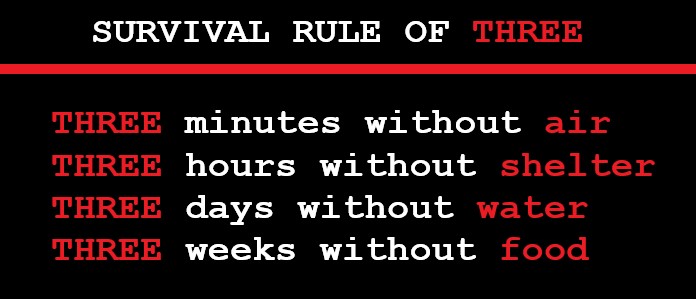
Yeah, it’s that important. Now, I could include things like clothing as part of the shelter system, as in having a raincoat to protect from the elements, but I’ll cover clothing seperately. When looking at shelters, there are a few options and I’ve previously covered it in The Camping Guide – Tents and Shelter, where I’d argued the case for a tent.
Tents are fine if you know where you’re going and it’s a short term stay, so for Milsim they work great. Purely for comfort, if it was a 1- or 2-night stay at a standard event, or just camping overnight somewhere for the simple joy of getting away from everything, I’d still take a tent. Everyone likes a tent because it’s comfortable. It has bug mesh, a groundsheet and it’s a little home from home. However, if we’re talking long term survival or a full milsim, the requirements are a little different.
A short overnight stay close to a car park means that you can carry anything you want really. I’ve done multi-day mountain hikes with a chunky 25-30kg pack which isn’t ideal, but it’s doable because I’m packing myself full of calories throughout. On Milsims, I have a habit of not eating or drinking anywhere near enough but that’s not as much of an issue because the kit gets dumped at a safe zone anyway.
I know there are more options, especially at Milsim events. You could argue for tents, tarps, hammocks, hotels, even the back of your car or van. But I think the weapon of choice here is the tarp, and despite being a lifelong tent fan, I’m going to explain why a tarp is the first thing going in my pack. And I could have written a book weighing up the pros and cons for all sorts of shelter systems for those who wanted a good read, but I don’t have enough experience with cars and hammocks to do it in enough detail. It’s been a couple of months of testing different tents and tarps that I have in the collection and this is where it led me.
The three main considerations I had were weight/size, versatility, and maintenance.
Weight and Size
Weight is obviously more important if you have to bug out, but it’s usually proportionate to pack size as well, and unless you want to pull a trailer along for a Milsim, it’s important for that too. If you enjoy wild camping in the mountains, then a smaller and lighter pack is going to make your life a whole lot easier.
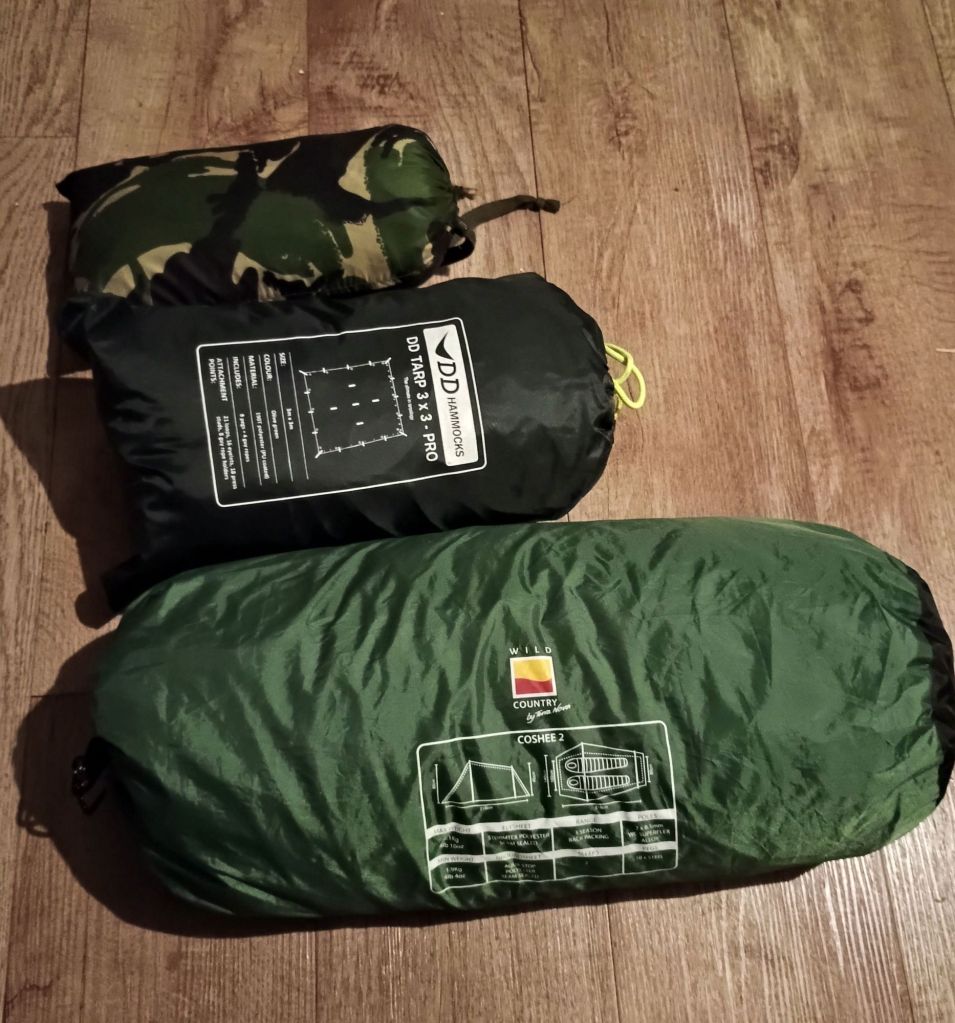
Here’s a size comparison for starters. In it, top to bottom, we have a 220cmx190cm DPM basha (tarp, but cooler, but unfortunately not square), a DD 3mx3m Pro tarp, and a Wild Country Coshee 2 man tent (like a Vango Banshee), which is my regular pick for wild camping and Airsoft events. I have a selection of 2- and 3- man tents, as well as larger 4-6 for family trips, and this is the smallest and lightest but it still dwarfs the two tarps in comparison. The tent isn’t a particularly expensive or specialist one, and I know it’s possible to get smaller and lighter “tarp tents” or hiking pole tents which will pack as small as the tarp, but in those cases you’ll need to account for the fact you have to add walking poles to that anyway.
The British Army Basha is a superb and robust bit of kit, and fits into most backpack side pouches leaving the main compartment free for other stuff. It’s big enough for one person plus kit, but if you want to do some tarp origami and fold it into more of an enclosed tent style shelter, I’d go for a 3×3 tarp. Anything bigger than that is unnecessary, it’ll be easier to spot if stealth is an issue, and with a bit of wind the whole thing will turn into a sail. The DD 3×3 Pro I’ve had for a few years now and it does well in some very challenging weather conditions, and it has enough attachment points to secure it any way you want.
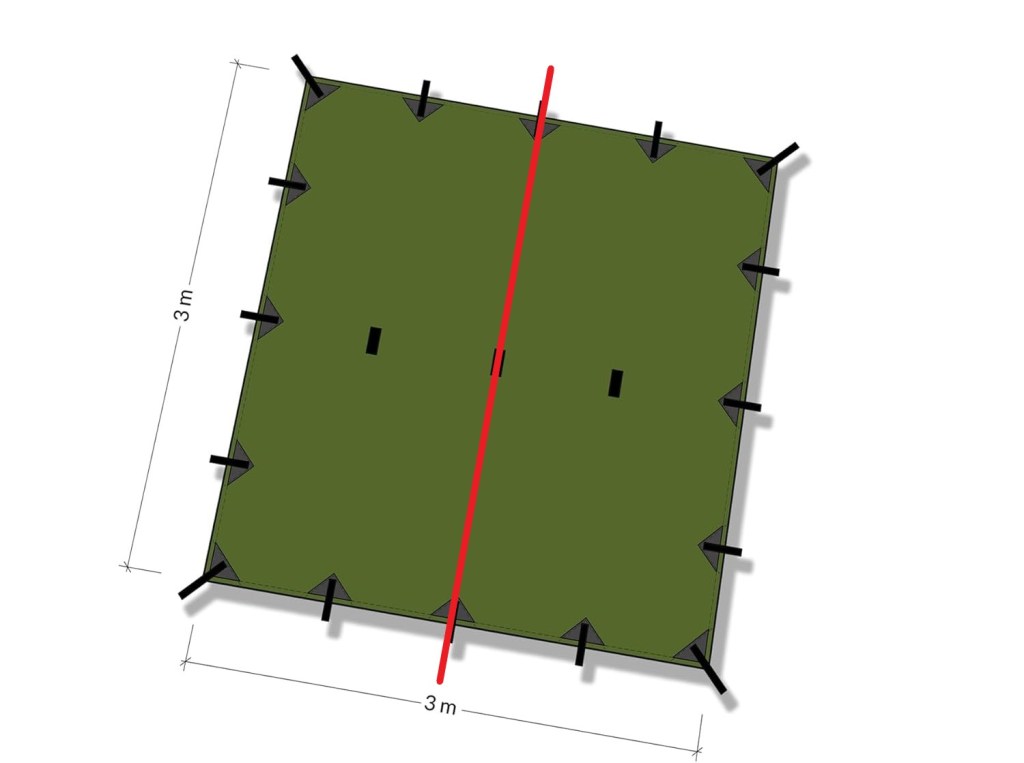
If you fold it down the middle along the red line, you can use the other loops in the middle to then pull the sides out and stop the inside sagging in on you. I know I’ve just said about the extra weight of walking poles that aren’t mentioned or factored in to some shelters, but I’d always take a couple strapped to the outside of the pack because there might not always be trees available to set up your tarp from.
I’m also not a fan of setting up tarps up in the air suspended between trees either – I like them anchored to the ground so there’s some weather protection. Walking poles are there to provide support, or keep the shelter from collapsing or flapping in the wind. Yes, that brings the weight back up to tent levels somewhat, but you can use the poles to walk with or as a shooting rest, so you’re getting more out of them as a separate bit of kit.
You can go smaller with army Ponchos to save even more weight and size, tie the hood up and set it up like an umbrella over your head, and it’s a great emergency option, but I’d go with something more solid and with better looped attachment points rather than a couple of grommets – it’s just easier in the long run. Ponchos I see a lot in American kits because they’re issued, whereas the British get the basha. I’ve often found when camping with tents though that a bit of extra space is extremely useful for sorting and maintaining kit, especially at Milsim events – I usually add a tarp to my tent to create a porch area.
You can get ultralight tarps made from Dyneema, which will cost quite a bit more but can be a little delicate if you really want to save a few more grams. I prefer gear that is a bit more durable though, and if I’m saving weight overall, I don’t mind adding a little back on for a cheaper polyester tarp that is going to survive better. The market is full of really cool, minimalist, ultralight stuff but the trade off is that a lot of it might only last one or two trips, and that’s worth remembering for all your gear and it’s something driving all my kit decisions. Survival needs reliability, because sometimes you won’t just be able to pack your car up and go home and buy better next time. DD are a very popular choice because of the lower price point compared to a lot of brands, and they’re well made, so that’s my best recommendation because apart from a few rather budget “supermarket” tarps, I’m yet to see any other brand in action.
Versatility
Versatility is the biggest advantage of a tarp over a tent – it’s just a sheet of fabric you can use any way you want, although with some grommets, loops or other attachment points. A quick google, and you can see there are hundreds of ways to set it up, whether you use a tree for support, some poles, or just cut yourself some sticks. But it’s not just the shape of the tarp…
If you do use a tarp, chances are you’re using a bivvy bag too – a waterproof sleeping bag cover to keep your sleep kit dry. It’s easy enough to put your sleeping bag in the bivvy, and just stuff it into the bottom of your pack. It’s not a great deal of extra weight or space. What you have with the tarp and bivvy is then a very flexible system for Milsim. Milsim events take place in a variety of environments, and sometimes you find that you’re camping inside buildings, or in small confined spaces as your squad huddles up together. The issue with a tent is that many aren’t free standing designs, and you’ll need some ground to peg it into, and that’s where concrete floors prevent become a problem for tent users. Additionally, a tent has a set “footprint”, often a 4mx4m space to set it up in and peg it out.
The advantage with the bivvy/tarp combination is that you can set it up anywhere you can find a space to sleep, and adjust it to suit the environment. Pine forest with low hanging branches? Just set it up close to the floor. Indoors? Just lay your bivvy down and it will also keep the wind off if you’re in a derelict building that’s missing some walls or windows. Setting up behind a wall at the edge of a field for stealth? A half-sized tarp will be enough. If you’re in the woods and find a (sturdy) fallen tree, you can drape the tarp over it and sleep underneath. The real strength of the tarp is that you can set it up absolutely anywhere. And, as much as I can set most of my tents up blindfolded, it’s quicker.
Maintenance
If this is a SHTF situation, maintenance is more important but it also applies to multi-day camping trips or Milsims, if you’re lucky enough to have any. Maintenance is more than just patching up holes though.
In the UK, where I have very much experience, it rains a lot. It’s March 2026 and I think we’re now on a 90 day streak. Rain brings about a whole host of problems if you’re having to maintain your kit over a period of time. When I do wild camping trips, or weekend events, it’s one or two nights. If I go for a two week camping holiday, it’s usually at a nice campsite in the mountains during summer months and maintenance isn’t an issue.
If the tent gets wet, it gets packed up and as soon as I get home after my one or two nights, it goes somewhere warm to dry out thoroughly. What we all like about tents is that lovely fabric inner tent that creates a nice, comfortable room to sleep in, which is extra warm and keeps bugs off us and the wet outer tent off our kit. However, sometimes it still gets wet despite your best efforts. When you try to fold your tent away in the morning, it inevitably gets damp as you fold your rain-soaked outer and guy lines to fit it back into the bag, and then if you don’t get it dried off properly, that lovely inner tent starts to grow mould. Tent inners are comfortable in the right conditions, but a nightmare once wet.
I know single skin tents (basically just the outer) are prone to condensation but most tarp setups allow good air flow. And if you’re in your bivvy bag anyway, it shouldn’t matter and your sleep kit will be dry. A single skin tent is basically a tarp anyway but with a set shape (see “versatility” above). The advantage a tarp has here is that the fabric is waterproof and the excess water can be shaken off, and if you have a dry day just hang it off your backpack to dry off further if needed. You can use a credit card to quickly wipe excess water off the outside, and pack it away with far fewer concerns about mould growth. I’ve never really felt that the inner tent does a great deal for warmth either, because your sleeping bag and insulating mat are doing the bulk of the work there.
It also doesn’t suffer from broken poles in the way many tents do, and you may not be in a position to just go home the same day and order a new one. If the manufacturer wants to help of course. It’s not a problem if a zip breaks either. Fewer parts make the tarp a much more reliable long term shelter and that’s essential if you’re far from home for a few days. If you’re carrying a tarp pole or walking pole for support, and lose or break one, it’s just a simple stick to repair it or you can get by with other tying points.
The DD 3×3 is going in the pack for sure, but so too is the DPM basha. In terms of space, the two still take up less room than my average 2-man backpacking tent, and they weigh less. Taking the basha as well means that I have a decent groundsheet without bringing a thick, noisy, heavy gardening tarp, and if I want a lower profile I can just switch them over.
220×190 vs 300×300 might not seem like much of a difference, but it’s roughly another third added on in each dimension so if I do need a smaller tarp that’s still enough for me and my kit, I have it without adding too much to my pack. Everything that goes into the pack needs to add value, and the versatility of the basha adds a lot. A sit mat, a groundsheet, almost a poncho if needed, and yes it can be used as a stretcher but that’s not much use on a solo camp.
The last thing to do is add some paracord ready to 6 attachment points on each tarp. I cut 4x150cm lengths for each of the corners, and two 230cm lengths for the “middle” attachment points, mainly because I had some 1500cm lengths of cord to use. Of course I can add more if I need to, but this gives me enough for a basic setup in bad weather which gets a shelter up quickly.
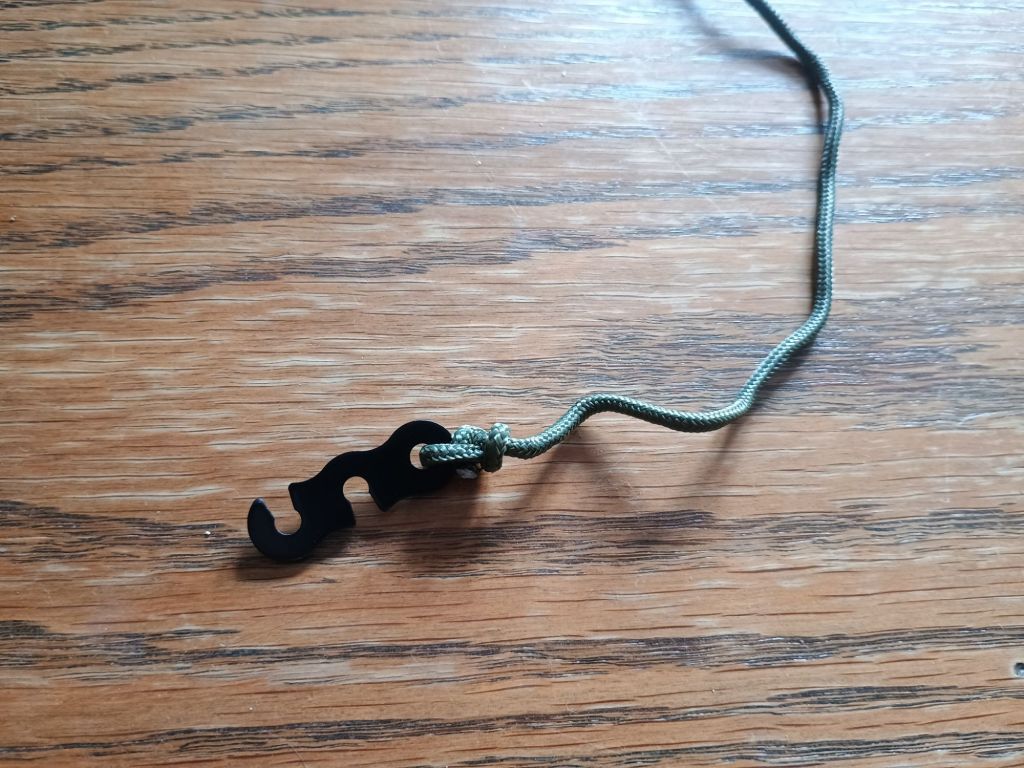
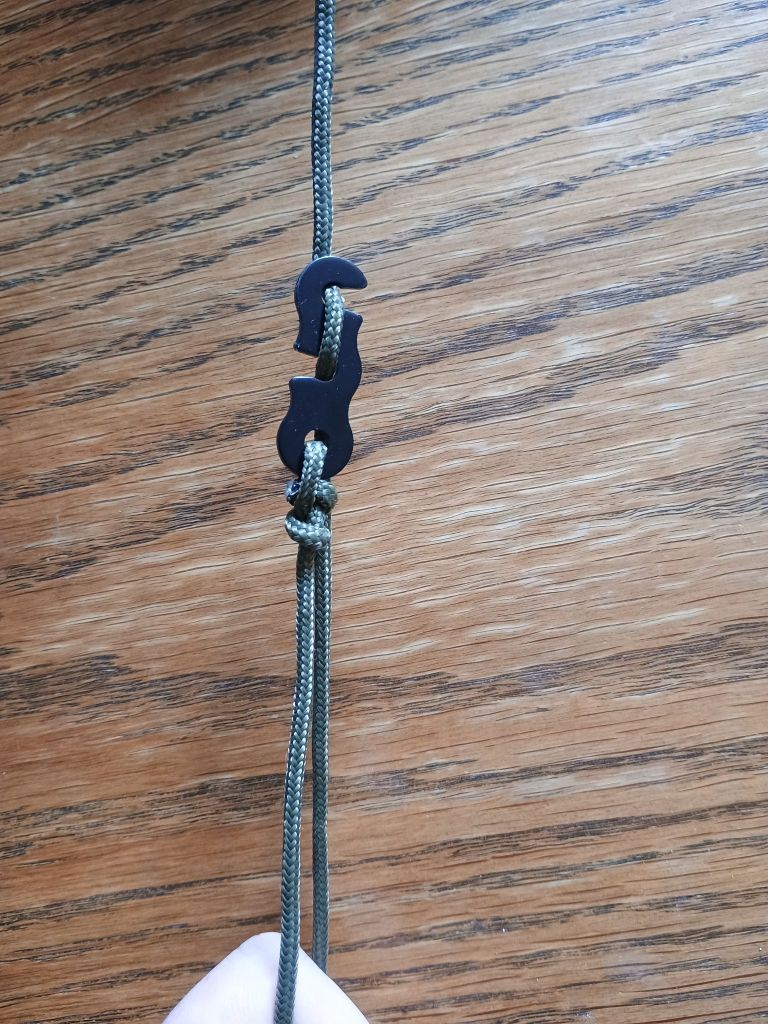
On that note, I ordered a pack of 20 of these line tensioners for my lines. I know I should get all bushcrafty and master 50 different knots, but if I’m setting up in cold, wet weather having not eaten properly in a few days, which is the worst case scenario, I’d rather save all the messing about and have a quick and easy solution. These tie onto the end of your line, you just clip it back over and it slides and locks into place so you can slide it and tension your lines quickly and easily. I’m not apologising, and I’m not making my own out of carved sticks and taut line hitches. These tensioners are cheap and do the job nicely.
So there’s my thoughts on shelters, does anyone have any different ideas? Keep it simple, keep it reliable. Just like the rest of your gear.
 Stipsniper.com