
Anyone can become a sniper, but not everyone becomes a good sniper. Like any skill in life, you get out what you put into it. Being good at anything takes time, patience and understanding.
A long time ago, a myth started circulating online that being a sniper was either difficult, or boring, and wasn’t suited to beginners. Usually posted by players who had failed at it and were left scratching their heads as to why, and assuming that same advice must apply to everyone.
It doesn’t, but to become a good sniper you have to become a good sniper. It’s a very different approach to running around playing CQB, peeking doorways and windows like a meerkat on a caffeine high. It’s easy to pick up some kit, throw yourself into the chaos and hope that luck is forever in your favour. Being a sniper is a different discipline altogether. Does it suit everyone? No. Can anyone do it? Yes, with the right mindset. And that begins with what you want to get out of it.
There are two types of Airsoft sniper that I have seen in all the years I’ve been doing this. The cosplay sniper, who picked up a ghillie suit off an Instagram advert, bought a fully upgraded rifle and wants to play as a sniper, by looking like one.
Then there is the true sniper – maybe only 10% of the total ghillies at a site. The student of camouflage and tactics. The one who is a sniper.
The Cosplayer
The Cosplayer is the one who wants the attention. Professional photographers, videos, individual sponsorships, documenting their day publicly and winning the adulation of their thousand strong following. Unfortunately I don’t do video editing guides, I’m no social media guru and I’m not a collaborator for extra attention. This isn’t the right place for that kind of content.
The True Sniper
I created this blog for the minority who wanted to elevate their game. The sniper who seeks neither attention nor recognition. He simply wants to practise his craft. The one who finds satisfaction in the experience, not the applause. The best snipers are the ones who take the time outside of game days to study and understand camouflage, and it isn’t just a case of buying a big shaggy suit to wear and laying still.
I started in a time when snipers really were solo players. You wouldn’t see them socialise much through the day. They disappeared at the start of the day and reappeared at the end. You didn’t know where they were, but you knew they were out there somewhere. That quiet approach added a lot to their game. I don’t mean that all good snipers are quiet types, but certainly they have a degree of control when discussing their craft.
Off the Field – Low Impact
They didn’t seek out photo opportunities; certainly, showing yourself in your ghillie too often gives your opponents familiarity with how you look.
They didn’t film themselves, because why show your opponents where you are and how you play?
There are a few small teams of snipers out there, not public groups of course, who group together to share knowledge and ideas. Not those who play as a mass of polyester leaves, but those who will share their tips across sites and even countries.
The true sniper players for themselves, against themselves. To improve on the previous experience, to learn from mistakes, and to apply more knowledge. It isn’t to do it for an audience. That’s not necessarily to say that those who film are bad players, but certainly if you watch anyone in Airsoft with a GoPro on they’ll take shots they wouldn’t normally risk, or make movements that might expose them, in exchange for better footage. It’s especially applicable to snipers, where we have to be extremely careful in order to remain undetected.
If you want to get a lot of views and play up for an audience, for sure get out there and take some wild shots, put some music to it and get your reactions to it.
But there’s a quiet efficiency in those who shun the attention to focus on being the best they can be.
The ghost has no obligation to entertain. No pressure to produce highlights. No reason to expose himself for a photograph. His decisions are governed entirely by what he believes the situation requires.
On the Field – The Ghost Who Walks
To begin with, the equipment should be as minimal as the game allows. The perfect day for a sniper could be 20 kills and zero deaths – that means being out there undetected for the duration. One thing many players miss on their loadouts, especially loadout guides and videos, is hydration and energy. Sniping is generally harder work than CQB. Moving further, through more difficult terrain, and holding position and concentration for a very long time requires the fuel to do it.
Having a weapons platform that takes very small mags, like a VSR for example, reduces the size of your load bearing needs. Trade realism for any advantage you can get. If you do carry a pistol, a smaller lighter one is better than a big clunky Desert Eagle or Mk23. Keep everything off your belt – you need your legs to move, and weight there is going to slow you down. High on the chest is the best solution. Remember as well that there’s likely times you want to go prone to present a smaller target, so all these trendy dangler pouches are out. When you build a rig, lie down on the floor in your house and work out where you can access stuff in this position.
Keep your ghillie light, and try not to have too much dangling off it that could get caught in the undergrowth. Overdoing your 3D decoration, or trying to add natural vegetation, is going to slow you down moving through the terrain. Yes, I know “veg is the edge” for real snipers but they’re playing a very different game and it doesn’t all translate into the Airsoft version.
When it comes to the gun, bolt actions will always be the stealthiest option. Use the Silent VSR Guide to help. A single shot bolt action teaches you better shooting disciplines, such as when to shoot and when not to (see Shot Selection article), to avoid getting a bit trigger happy and exposing yourself. A sniper with an MP5 is either sponsored to use it, or is just a CQB player wearing camo. Also, try to go with a small scope – big 40mm/50mm scopes create a recognisable shape in the bushes, even with camouflage. I use a 4×32 as the largest. It doesn’t affect how much you can see.
Check your kit over, make sure you tape any rattles (always good to have a roll of Scapa Tape in your kit somewhere) or metal buckles. I always recommend in-ear buds for radios to keep the noise contained without broadcasting it everywhere, and make sure you only have one ear occupied with the radio – the other ear is your threat detection.
The goal as a sniper isn’t to run around in the open trying desperately to hit as many players as possible – you get no prizes for all those hit markers you want to add later. The job of the sniper is to create problems for the opposition. Making areas difficult to navigate because there’s an unseen threat there, preventing access to objectives, or simply keeping numbers of the opposing team busy while your team uses the numerical advantage to win.
The sniper is a solo player, but playing for the team rather than individual accolades.
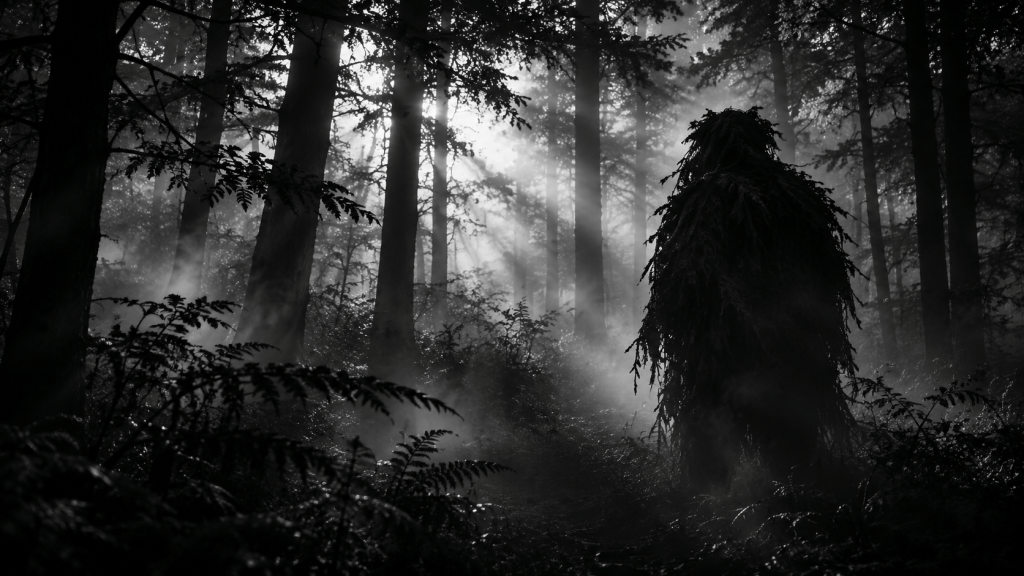
Once the game brief is done, head into the field but avoid giving any information away as to where you’re starting or what your initial plans are. If nobody minds, on the walk to the starting point just casually disappear into some vegetation and let everyone forget about you. And this is where not everyone succeeds – if you want to just get out and chat to your mates while slinging plastic, then this isn’t the role for you.
Get comfortable with your own thoughts and your own company, because from here that’s all you have.
Don’t rush straight into the action. Don’t immediately assume that the route you had already planned was the best option; it might be occupied. Flexibility of thought is a key skill – learn to always have multiple routes if you do plan ahead, or just get very good at reacting to situations and finding solutions. (see Proactive vs Reactive sniping)
At my local site, Dirty Dog Airsoft, there’s a particularly good spot for snipers but it’s always occupied by a queue of snipers and of course the opponent knows where to look. You have to look for places that nobody expects you to be in (see Machine Gun Theory). This is why it doesn’t make sense to film your adventures.
Learn that there are times when you’re away from the action when you can move quickly to gain ground and switch positions, and there are times when the action is close and you need to go into full stealth mode. Walk on the outside of your foot (heel first, press down on the outside from heel to toe and then slowly flatten the foot). Of course, watch your footing and try to move when there’s something happening, such as a fireifght where other players are distracted, or a plane flying overhead that just masks a little bit of the noise – players will listen first for the plane.
If you do have action nearby, you’re likely not the first target or the focus of attention. You only become visible if you move or take a shot, so choose wisely when to do either. Don’t spend too long looking for a good shot. The priority is always situational awareness.
1. What is happening around me
2. What are people doing
3. Where are they
It’s not a role where you’re running around looking for targets to line up to your red dot, finger on a hair trigger going full Leroy Jenkins.. Our goal isn’t so much to get kills, but to stay alive out there and keep the opponent guessing. A live sniper in an area is worth ten dead ones.
Always quietly scan and check for threats. Listen to all the noise around you. Use it to mask your actions.
Don’t celebrate kills. Enjoy the satisfaction of the hit but remember you’re still in the middle of a fight – immediately get your finger off the trigger and reassess the situation. Don’t debate hits or non hit taking, don’t go and argue with site staff. If the opponent cheats and you get up to argue, you get spotted. It’s frustrating, but we have to focus on staying stealthy.
Return to Base
When you get back to the safe zone, don’t jump into stories about where you were or where you hit players from – discretion keeps you hidden. A simple nod and a smile will do, and you can boast about how well your rifle is running, or complain that your comms went down. Don’t focus on, or let them focus on, the ghillie. Get that off and packed away out of sight.
Our game isn’t just about hiding oursleves, it’s about hiding our intentions and methods, our game plans, pretty much everything. You wouldn’t jump up from a good hiding spot and shout “Hey guys, I was here the whole time!” in a game; why would you do it afterwards?
Stealth isn’t just about the ghillie suit. It’s about our whole behaviour. On the field and on the internet afterwards.
An elegant role, for a more civilised player.


Leave a Reply