An important concept for anyone who has an interest in camouflage, it is often overlooked but can make all the difference to your suit (or whatever you want to camouflage). Explaining it though, when you ask any Airsoft sniper, is a little tricky. If I asked a hundred Airsoft snipers, I’d get a hundred different answers, and after someone asked me this week I realised remarkably I haven’t covered it anywhere in 300 articles which was a bit of a let down.
So, I’ll give it a go…
POSITIVE –
Foreground
Defined ‘hard’ objects
Brown
NEGATIVE –
Background
Fuzzy, blurry
Green
Or at least that’s how I see it in my head. Positive space elements on your camouflage might include things like dead brown leaves, sticks, twigs, stones. Which is easy enough, because we’ve been gluing elements like that to suits for ages. Positive space is the bit that people understand when they come to build camouflage systems. We’ve mastered that part.
Negative space is a little harder to define. It’s the stuff that is there but not distinctly, like looking at a field of grass and seeing that it’s green but not being able to pick out shapes within it. It’s like a background texture. On many suits it may be the background fabric that resembles the surrounding dirt, and then you add positive space elements that have clearer definition on top.
Apart from the dirt, I would usually think of negative space as green stuff, like leaves on a bush or blades of grass, using materials such as Haloscreen which has softer edges and textures as well as allowing different levels of light and colour through the mesh material. Although in 2026, Oakmaster have released positive space greens as well, I generally use the brown/green analogy to help explain the concept. You wouldn’t use negative space browns elements in any crafting because brown elements in nature don’t allow light through (dead sticks, rocks, mud etc), which was one of the errors when Novritsch released a ghillie mesh but most of it was brown coloured.
This is where a good base suit and pattern lightly camouflaged with 3D elements always beats a heavily crafted leaf suit where the base pattern is completely hidden by positive space dead leaves for example. The effect we want is to create depth on the suit; not just physically but visually.
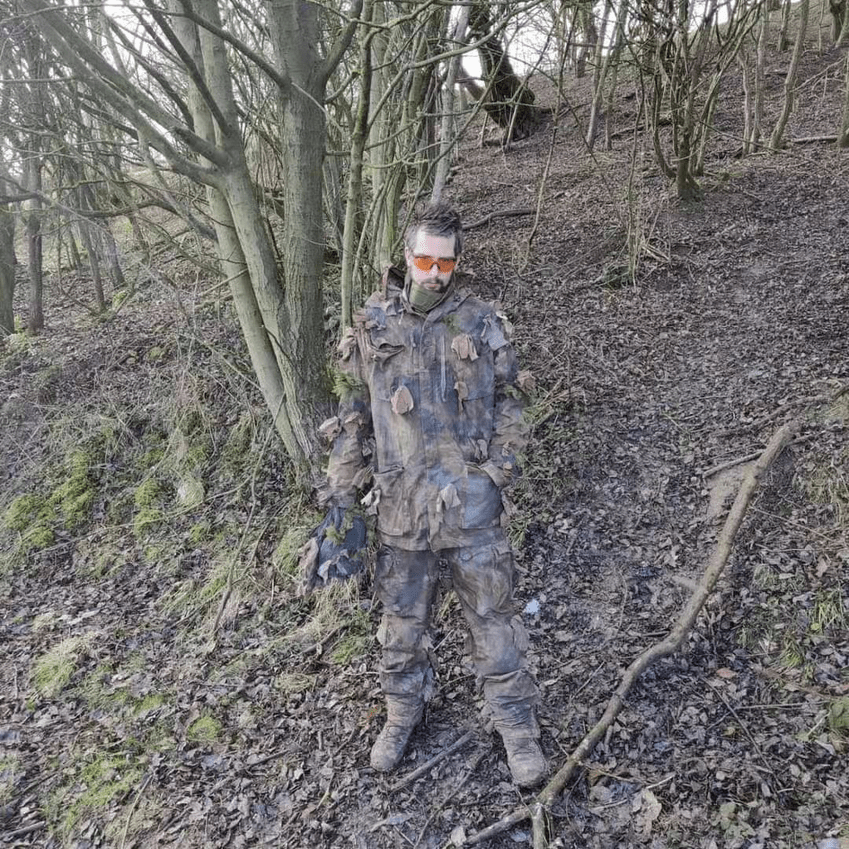
This is probably the closest example I have to hand. The base of the suit is blending into the dirt of the background, and the 3D elements stand out against it to create that foreground/background illusion and avoid having it as a solid human shaped mass of leaves, which is unnatural and is recognisable as a human sized and shaped figure.
The ultimate goal if you’re doing a ghillie suit as an example if that you want to hide and disguise the human shape and outline, creating illusions of depth using positive and negative space helps that, as well as the usual shape break up using contrast and pattern, but the more methods we combine together the more effect
This probably isn’t the definitive answer to positive and negative space, and once you grasp it it’s probably easier to visualise in your head than to try and put into words. Hopefully Google bumps this up the searches so it’s out there for people, so if anyone else wants to have a go explaining underneath then please feel free!
What, you thought camouflage would be easy?

