After a few months of shopping, I finally picked up a pack for all my travel and adventures and it really did take a lot of looking before I decided on one that suited my needs. I’ll do a seperate review of the one I’ve been using, but I wanted to talk about how I chose it, and more importantly, why. If you’re doing a milsim, or travelling, or get stuck in a SHTF scenario where you need to get away from trouble, then ultimately all your gear needs carried. For many, having a car allows you to ignore weight and size and stuff as much crap as you want into the boot/trunk/kofferraum or wherever else you have space. Easy.
But you might find that you’re turning up to an event and having to carry your kit a mile across the site in terrain that the car cannot go. You might need to abandon your car. Or you might be environmentally sound and not own a car. In these situations it makes a lot more sense to be more careful with your packing and aim to get everything you need into one tidy bag so you can grab and go.
For most of my Airsoft events down the years I’ve lived out of 100l holdall style bags, because it just has to live in the safe zone. For hiking, I’ve had an 80l rucksack that was bought for me by my parents when I turned 18 that sadly was falling apart, and so the time came to invest in a new one. And it definitely wasn’t going to be a holdall, because that’s been a nightmare travelling on trains and planes. The requirement was a “one for all” pack and the first thing I noticed was that prices have really gone up in the last decade…
Bigger is better
It just is. Size matters. And this is where most experienced hikers and ‘tubers will cry out that it isn’t. But I’ve been hiking since I was a very small child and I’m not new to this. I know many YT personalities take pride in being able to pack a week’s worth of supplies into a 28l backpack but the first thing I notice with these people is that most of the gear is then strapped to the outside of the pack to make it all fit. I don’t want stuff on the outside, I want stuff on the inside where it’s safe and dry and I don’t have anything hanging off to catch on things. If I do need to catch a flight, it’s especially important that everything is on the inside.
The last time I remember going rucksack shopping, which was many years ago in a place called Ambleside in the Lake District, UK, sizes tended to be 80-120l for the larger ones. That’s just what you used as standard for longer hikes. Understandably, the gear that goes inside is now smaller and lighter so there’s less need for such a huge pack. Most now sit at the 65l mark, and I certainly wouldn’t want to go smaller. I know some will say “well if it’s too big you’ll just fill it with stuff you don’t need”, but I’d rather have some spare room in my pack in case I need it, than buy a 40l pack and then realise I need a bigger one or need to add some pouches on in colder weather or for longer trips. It does no harm to be bigger than you need, but causes endless problems when there’s just no room to pack your coat in, for example. I know most good survivalists will show that you can get away with a simple daysack, but that just doesn’t have enough flexibility
The pack I picked up in the end was a Karrimor Sabre 60-100l. Basically a 60l pack with zips down the length from top to bottom that release extra material and expand the bag capacity to 100l if needed. And that’s especially useful on a wet morning after a camp where absolutely nothing goes back in its bag the way you originally packed it.
Bombproof
I mentioned in a previous article that my first thought when shopping at my local outdoors store, was that modern backpacking packs like the Osprey range are incredibly light, but also incredibly thin.
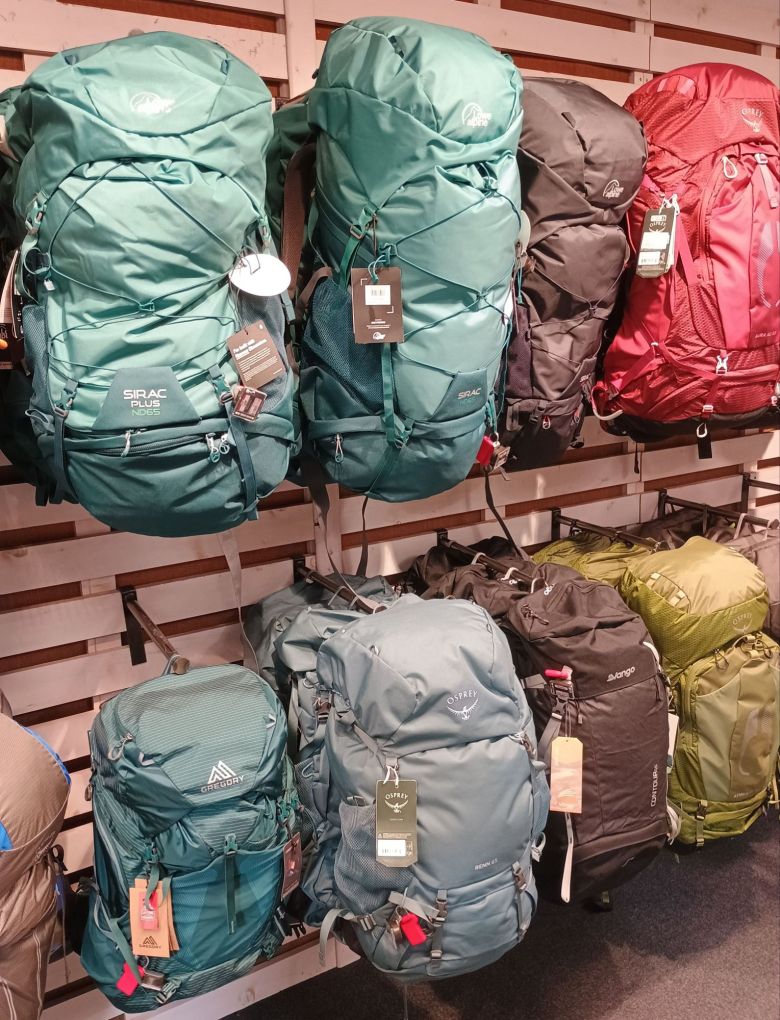
“when I picked a few of these bags up to look at, I was amazed at how thin the fabric was on them. In some cases it was like putting your gear into a plastic bag”
I know Osprey in particular have a great reputation among hikers, and I wouldn’t have a problem as much if I was just hiking along with it on my back, out of harm’s way. But would it survive being thrown onto an airport carousel, dropped from the back of a vehicle during a Milsim, or dragged up a cliff on a rope? I wanted a nice, old school cordura bag and I’m not bothered if it looks tactical – this thing needs to be functional and stand up to some abuse. I don’t care if it has cartoon dinosaurs printed all over it, as long as it works. Thankfully, that wasn’t an option…
Of course, it’s not just the materials that matter – it’s how they’re put together. I could have picked something up from Temu for £30 that ticked the boxes, but I just wouldn’t have any faith in the quality of the manufacturing. As much as I’d rather be able to allocate budget to other cool things, it was looking very likely that I’d be spending between £200-£600 to get what I wanted. You operate out of your pack; it’s more of a home base than your shelter setup. You have to be able to carry it anywhere and if it fails…well, you’re going to struggle to take your kit any further. It’s an important part of your kit and the important stuff needs investment.
Compartments
Many years ago, I bought a 50l molle pack off Amazon just because everyone else was buying them and it looked a decent daysack at the time. You know the ones…
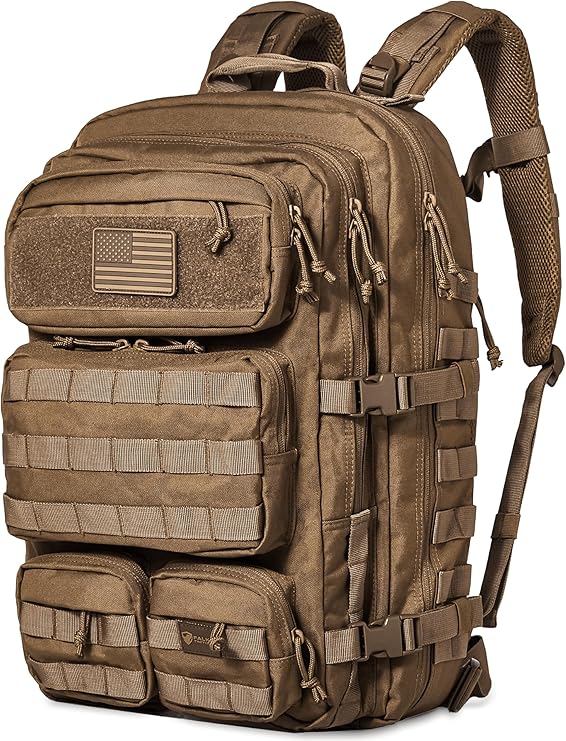
Anyone in or around Airsoft, bushcraft or military I’m convinced has or has had at least one of these. They’re kind of good for organising your stuff, but I quickly found that the main compartment was just too small for some things. And if it doesn’t fit in the biggest compartment, then you can’t carry it. It’s not so much a 50l pack as a 20+10+10+5+3+2 set of pack stuck together. Now, in the old days your pack was just one big compartment with a couple of straps to carry it. Everything went in, you just stuffed it inside. Much like a sleeping bag stuff sack, you just shoved it in and fastened it shut. That’s how I like my bags. If you have to pack up in a hurry, like a sudden thunderstorm or you get flanked because your team wasn’t paying attention, there’s room to just throw everything inside and clip the lid shut, and organise it later when you get the opportunity. I didn’t want something that I’d have to sit and carefully file things away into twenty separate small pockets in order to get things packed up. Most packs have a lid pocket for the really important things, the less important stuff you can do when you make a stop and have time to open the pack.
One of the bags I did look at was the Warrior X300, which is a very good quality 80l pack, but has a very clever set of compartments inside side compartments, and it just put me off. I am a simple man, and I like simple kit.
Molle is a fantastic system for adding extra pouches and carrying capacity to your pack, although hopefully you wouldn’t need to, but what I like more is the old British PLCE system. I had a couple of brand new Karrimor bergen side pouches that zip and clip onto the side of compatible packs, adding an extra 10l each side without having to weave molle on and off, making it a quicker system to seperate your gear. If I could find a 60l pack with compatible zips, those two side pouches add a lot of extra space. Additionally, by carrying a compatible yoke, you can zip the two side pouches together to make a 20l daysack, which is a bonus.
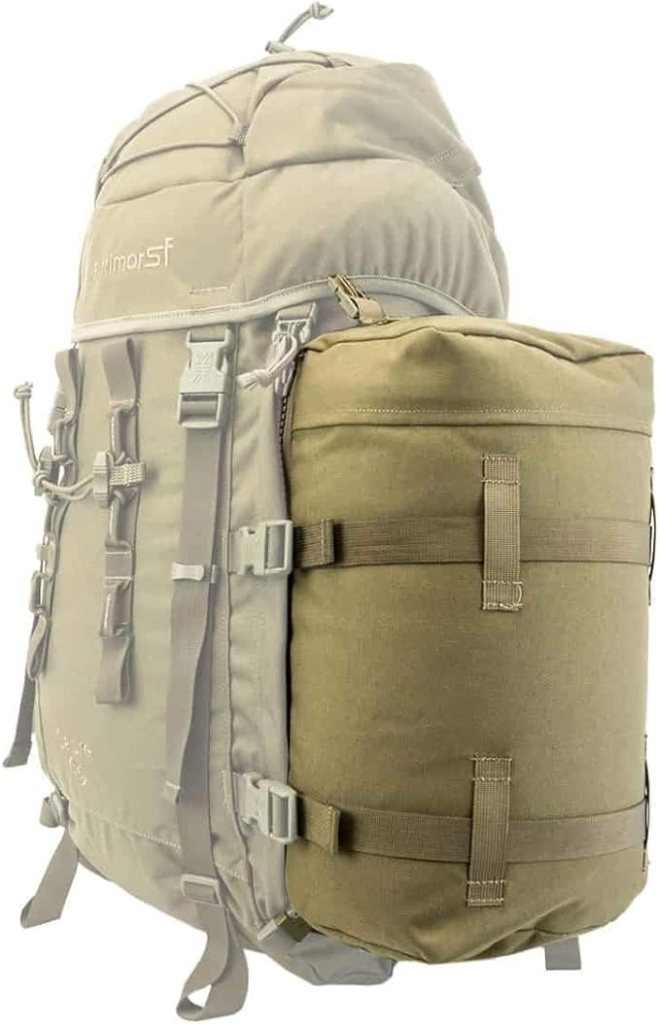
When I thought about how much I wanted that feature, it did narrow the search a bit. Although I’ve said that I wanted everything inside the bag, being able to add side pouches or customise your pack, whether it’s molle or PLCE, is a useful option. I wouldn’t go as far as making a pack covered in mag pouches or small utility pouches to the point it’s more populated than your chest rig, but being able to add a water bottle pouch for milsim or similar isn’t a bad idea.
I think if it was purely for milsim, I might have decided a few external pouches would be useful for splitting off combat gear as long as the main compartment was still a big, useful bucket type space I could drop things into.
Although I settled on the tried and tested Karrimor Sabre, a few of the alternatives I looked at were :
- Highlander Pro Force 66l. Highlander do some pretty decent kit, and it was definitely an option but for the side pouches not being PLCE. Quite a bit cheaper than the alternatives as well.
- Wisport Raccoon 65l. Wisport make excellent quality packs and it’s reflected in the price. Almost hit “buy” a few times on this one. I’ve never heard of any complaints about their kit.
- Warrior X300. I have a friend who runs one and I’ve seen it many times. Great if you like compartments for things, and the front access is handy. 80l capacity but molle everywhere to expand it any way you like.
- Berghaus MMPS Spartan 60 FA. The FA stands for Front Access, it zips open at the front so you can get to the contents. It has Molle, it has PLCE compatible zips for side pouches, and it’s a lovely colour. Does have one flaw, which I’ll get to in a minute.
- Austrian KAZ 03 65l pack. A great surplus option, have a dig around on ebay and you can pick these up for £30-£60. A fairly simple design and it did appeal, although slightly limited expansion space. However, you could just pack less stuff.
- Dutch Army Lowe Alpine Sting 60l. Another surplus option, but if any more DPM came into the house, Mrs Stip would end my life whilst I slept. PLCE side pouch compatible, it’s a Lowe Alpine brand pack, which means great quality but at surplus prices. Also comes in a bigger 120l version, the Saracen.
- Tasmanian Tiger Raid Pack MkIII 52l. Another one that narrowly missed out due to the PLCE side pouches. A touch smaller than the others but another that’s heavy on the Molle for more attachments where needed.
And that’s the thought process behind the purchase. If you need good gear, it’s worth taking the time to sit and plan out what you want from it, why, and whether it fits your budget. Don’t just jump on things because one (paid?) influencer says it’s the greatest thing ever. Do some research – there are tonnes of videos and reviews out there on everything and it’s worth taking the time to listen to positives and negatives. I was fairly set on the Berghaus Spartan 60 until I found a review by a guy who had been hiking a lot and noticed that with his walking motion, the sharp end of the aluminium frame had worn a hole in the bottom of the bag. And that wasn’t mentioned by any of the other reviews.
Next up, I’ll do a review of the Sabre 60-100. Anyone got any other recommendations?

